I’ve always been one for spooky spaceship stories. And while there are some terrific deep-space horror movies out there, I’ve had a much harder time finding a book that fits the bill—for whatever reason, it’s a subgenre with relatively little presence in print sci-fi. So you can imagine I was intrigued when I found an extensive list of sci-fi horror books on Goodreads. Near the top of it was Phillip P. Peterson’s 2019 novel The Dark Ship, marketed as a cross between Event Horizon, Alien, and Pandorum. Seems promising, right?
Turns out I’ll have to keep looking. For today’s review, we will explore a deeply flawed novel.

Our heroes are the crew of the space bomber I.S. Charon, who open the book on a raid against the rebel-held Acheron system. The POV character is Captain Jeff Austin, who, despite his rank1, is only the executive officer, and a meek and indecisive one at that. None of the enlisted men take him seriously. Major George Irons, the ship’s commander, is a grizzled veteran who garners much more respect. There are eight (!) other named crewmembers we are expected to keep track of; I don’t think I ever managed to get them all straight.

Now, the crew of the Charon achieve their mission, destroying the target with a planet-shattering Quagma bomb, but this victory comes at a price: all the other bombers from their strike force are shot down, and the Charon sustains fatal damage, limping back into hyperspace with its antimatter containment minutes from failure. They need to abandon ship—and soon. Their base at Sigma-7 is too far away. There are no inhabited systems within reach. Without any other options, Major Irons orders them to bail out on an asteroid in interstellar space, where they will hold out for rescue. But as they approach, they discover it isn’t an asteroid at all. It is an enormous alien starship.
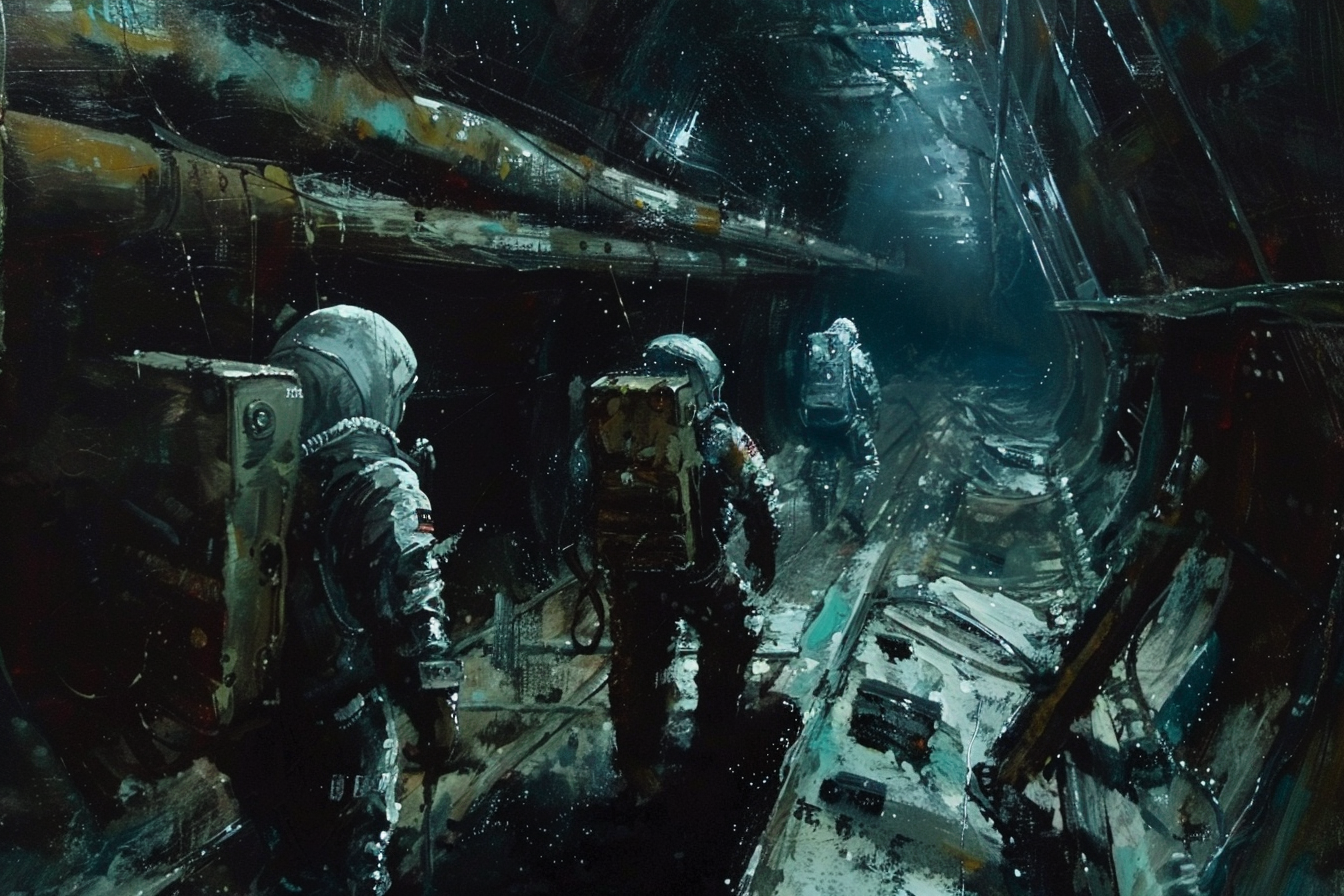
One of the novel’s more picturesque moments is when the crew detonate a nuclear warhead at a safe distance from their own vessel, using its flash to momentarily light up the metallic terraces and antennae and spires of the alien ship. There’s no telling how long this thing has been out here; it makes no response to their attempts at communication, but there’s clearly something alive on board, as it lights up a landing pad and opens an airlock. The crew of the Charon have no choice but to get inside, while their stricken ship explodes behind them.

Only after they board are they greeted by the alien ship’s main computer. It speaks English—the result of eavesdropping on human radio signals, apparently—and it seems willing to take in the stranded crew of the Charon, arranging comfortable living quarters for them, and agreeing to transport them back to their base. This isn’t a fast ship, though. The journey will take several months. Our protagonists face a long wait aboard an unexplored spacecraft, stuck within endless miles of labyrinthine corridors. And of course, not all is as it seems.
SPOILERS
This novel takes a sharp turn around the halfway point. After a painfully long period of nothing much happening—just explorations of empty rooms and drearily repetitive conversations among the crew—the stranded bomber crew finally uncover signs that other intelligent beings were aboard this ship. Then people start dying, mutilated in horrific fashion by alien creatures. The computer’s answers become increasingly evasive. They discover it is not, in fact, taking them back to their base; they are on a course to Earth, for reasons unknown.
When one of the creatures kills Major Irons, Jeff finds himself thrust into command, and he leads the survivors deeper into the ship, desperate to uncover the truth behind all this. What they find shocks them. Far beneath the surface, within a vast interior cavity, lies Hell itself: a barren, rocky landscape, populated by human beings forced to torture each other in an endless cycle of death and rebirth. The descriptions call to mind Gustav Doré’s famously grim illustrations of Dante’s Inferno. Abandon hope, all ye who enter here!

It turns out the ship isn’t actually Hell. But it is run by a sadistic alien who took over long ago, killing or imprisoning his fellow passengers, and has spent the last million years torturing sentient beings for his own amusement. With the original alien crew finally dying off, he’s started raiding human space for fresh victims. Taking the crew of the Charon aboard was all an elaborate ploy to obtain Imperial Navy communications codes, with which he can evade the defenses around Earth, and subject billions more to his cruel designs. Can Jeff and his crew stop him before it’s too late?
You might read that summary above, and think that there’s a lot to like. You’d be right. Conceptually, The Dark Ship has many elements that could have made a great book. But as far as execution goes… we are far from greatness here. Where to start?
As I mentioned above, the ten-man crew is entirely too many characters to keep track of in this kind of book, particularly given the thin characterization they get, and their sparse physical descriptions. Only after the first several deaths was I reliably able to tell who was who. The result is a terminal case of “Oh no, not… that guy!” syndrome, with the characters caring far more about losing people than the reader ever does. Only Major Irons and Captain Jeff were ever very interesting; there was a decent mentorship arc going on, with Irons coaching Jeff on overcoming his insecurities and stepping into a leadership role.

Characterization issues are not helped by some truly cringeworthy dialogue. Good grief, these people do not talk naturally. Conversations here are an ordeal to get through, bogging down the story with lame jokes, repetition of things that have already been made clear, and an obsessive need to discuss every possible explanation for every last mystery. They just won’t shut up:
- “My, it sure is interesting that there’s an airlock here in the depths of the ship.”
- “Maybe these aliens lived most of their lives in one air pressure, and mated and reared children in another. The airlock was installed to equalize between them.”
- “Yes—but they might also have installed it as insurance against a hull breach.”
- “But then why didn’t we see any other airlocks further up?”
- “Maybe this was an extra important area, containing high political leaders, or crucial genetic material for propagating the species.”
- “Maybe the airlock is indicative of class divisions within their society. Do you think they ever developed an equivalent to Marxism?”
I’m barely even exaggerating here. It really is that tedious.
Where this book fails most spectacularly is in the first task of the horror writer: creating atmosphere. At the sentence and paragraph level it’s about as riveting as my middle-school algebra textbooks. I don’t know what it is with indie sci-fi authors and barren prose, but it seems to be a common affliction—how hard is it to describe your world’s wonders and terrors in a way that won’t induce sleep in the reader? Here’s an example of what I’m talking about:
“Gradually, the red light grew stronger and they could see it shining a few feet above the ground. Beneath it was a platform covered in yellow and grey stripes and surrounded by a low railing. It was big enough that they could all fit on it. Attached to the middle of the railing was a narrow box with a square. It was similar to the elevator that had taken them down to the bottom of the cavity.”
Downright soporific. There’s no flavor! Just colors and dimensions and nouns without adjectives. Characters walk for X miles through Y number of corridors, finally entering a chamber Z meters tall, where they find nothing much of interest. Even the “exciting” chapters are delivered with a bare minimum of descriptive details. Gruesome deaths and tortures read about as vividly as Hallmark cards. Now, to be fair, this is a translation. Maybe it was better in the original German. It’s unclear exactly how much the author is at fault here, as opposed to the translator, but there are no indications that this would be a literary masterpiece in any language.
As for the editing? It’s a hack job. The ubiquity of “cavitys” instead of “cavities” is eye-watering, to say nothing of misplaced punctuation and misnamed characters. I’m amazed Peterson actually paid someone to edit this.

So—that’s The Dark Ship. The worst part is, it’s just good enough to convey glimmers of a much better novel. Some of the ideas in the initial space battle are wonderfully inventive, and the protagonist’s character arc had potential, with a nervous Jeff learning to exercise authority over his crew. On a macro scale, the plot is genuinely cool. But the fact that this book isn’t a total disaster makes it even more disappointing.
My verdict? This was a fundamentally good premise, botched by poor craft, rendered a tedious slog as a result. Go watch Event Horizon instead.
Rating: 3/10.
Thanks for giving this a read, everyone. And if you’re new to Let’s Get Off This Rocky Already!, don’t miss out on my upcoming reviews, posts, and other exciting space content—be sure to drop your email in the box down below, so that you get notified every time I publish.
I’ll see y’all next week!
- Keep in mind that these are air force ranks, not navy ones. Fitting for a bomber with a crew of ten, flying missions that are only supposed to last several hours—no space navy tropes here. ↩︎
Discover more from Let's Get Off This Rock Already!
Subscribe to get the latest posts sent to your email.