
When it comes to making quick, flashy imagery for this site, Midjourney has long been my tool of choice. It’s a godsend for my sillier and more lighthearted posts; I’ve used it to generate eye-popping covers1 for my short stories, and visuals for book reviews that would otherwise lack them. But it might not be the best service in town, anymore. Over the years since I started messing around with Midjourney, ChatGPT has expanded beyond its original niche as a text chatbot into an image generator in its own right. Our question today is: can Midjourney still make the best visuals, or has it been dethroned? Which of these AI overlords will reign supreme?

First, some background on exactly what these tools are, and how they work.
Midjourney was the first to come out, all the way back in July of 2022. Its parent company, Midjourney, Inc, is an independent Silicon Valley research lab founded and led by entrepreneur David Holz. Like other contemporary generative AI models, Midjourney has trained on vast quantities of data, which it uses to statistically predict the “optimal” response to a user’s request. In this regard it can be likened to an extremely good autocomplete.
You can access Midjourney either on its official website, or via the messaging app Discord2; users communicate with the AI through very specific syntax, most usually the prompt “/imagine [PROMPT]” to create an image based off a string of text, but there are plenty of prompts to blend or remix existing images, too. Plans start at a modest $10/month, scaling up to a whopping $120/month for those who really need processing power. There is no free version.

To demonstrate, let’s give it a prompt. For example: “/imagine [Retro sci-fi lunar landscape].” We press enter to send the command, and then, we wait. Sometimes it can take a while. Eventually, Midjourney comes back with a menu of options:

I like the look of the fourth one, on the bottom right. Let’s make some variations. Pressing V4 gives us another menu of four options, all derived from the chosen image:

You can make more variations on these, and iterate as long as you want. If you’re fussy about details, like I am, that might be a long time indeed. But, let’s settle on one of these first four. I’ll upscale the image on the top left—U1. Now we have an unearthly landscape of boulders, blue sands, and strange alien towers. We also have a new set of editing tools:

Suppose I wanted to get rid of all that junk in the sky? Simple. I would click “Vary (Region),” and drag my mighty lasso tool around everything I didn’t like. The program would then give me four options for how to fill that space:


Varying by region is a powerful tool. If you like parts of your image, you can keep them, instead of re-iterating everything from the ground up and hoping for the best. Let’s upscale #4 on the bottom right. Let’s also make it a little wider, using those blue arrows in the editor…

And voila! I have my retro moonscape, and you got a peek at how the sausage is made.
Now, for ChatGPT. I’m sure you’ve heard a lot about it in recent years. Far from a small, plucky independent lab, it’s a behemoth worth hundreds of billions of dollars, using more water and electricity for its servers than most small countries. It took the world by storm during its initial rollout, back in November of 2022. The copywriting and content-writing industries have been decimated as a result; impacts on society and culture have been substantial, to say the least.

ChatGPT started as a text model, so its text-to-picture capabilities are fairly new. Nevertheless, it does quite well in the visual realm, and it’s gotten a lot of attention on that front—just look at the whole AI Studio Ghibli phenomenon that blew up a few months back. While ChatGPT is free, you do need the paid version to access the advanced models and get more processing time. I use the $30/month plan, which offers about as much capacity as I need.
Generating an image with ChatGPT is simple. You ask for one.

It’s not the swiftest at generating things, and in my experience, it tends to return a lot of error messages, particularly when the servers are busy. But it’ll usually figure itself out. This is what it made from my above prompt:

Not too shabby! Though it’s clearly confused about what a conning tower is. And his cap sports a vaguely Lenin-looking blob instead of a hammer and sickle. ChatGPT doesn’t have any of the editing tools Midjourney does, so you can’t do little spot changes—you just tell ChatGPT what you want changed, let it generate a new image for you, and hope for the best. As an experiment, I wanted to put a helicopter in the top left:

There we go. Not even a bad-looking helicopter. Only very minor things changed in the rest of the image (see: the cap, and the lines on the captain’s face). One last alteration, just for shits and giggles:

So, we’ve looked at each of the rival AIs. But how do they compare against each other? It may prove revelatory to give Midjourney and ChatGPT the same prompt, and see how they tackle it. Let’s try… some robots fighting each other:

Midjourney gave me four images, all with markedly different styles and subjects. I iterated the one on the bottom right into the cover image for this post. What’s immediately clear is that Midjourney has no shortage of dynamism—just look at those poses. Action! Conflict! Excitement! We see lunging, jumping, swinging, and shoving, all with vigor. Granted, the details are murky. It’s unclear whether the robots in the top right have swords or laser guns. A robot in the bottom right may be missing an arm. These are splashy pictures, but they’re more style than substance.

We see the reverse with ChatGPT. The dueling robots and their anatomy are considerably more grounded here. Indeed, they’re mirror images of each other, almost identical in construction. The only oddity that stands out is the raised hand of the robot on the right; it’s holding something, but ChatGPT didn’t quite know what to make it into. Otherwise, this hits the mark. But—it feels a little sterile, no? A far cry from the balls-to-the-wall craziness of Midjourney’s interpretation. These are normal-looking robots methodically slugging it out, their poses stiff, their color palette drab and unremarkable.
Perhaps ChatGPT’s greater discipline will prove an asset in other areas. Take, for example, spacecraft and military equipment—areas with which I am unusually preoccupied. Midjourney has never proved entirely satisfactory on this front, to my frustration. Let’s give ChatGPT the following prompt: “Generate an image of a B-52 bomber in flight high above crystal-blue Pacific waters.”

Serviceable! Though one wing is thicker than the other, which is not what I was expecting. And it has the look of a bland render in a forgettable computer game. How about Midjourney?

The composition is a lot prettier here, it still has the thick wing, weirdly enough (unless I’m just hallucinating that). The elephant in the room here is the extra engine pod. Plus the underwing missile on only one side…
It’s pretty clear that while neither AI was perfect in replicating the technical details of a real aircraft, ChatGPT came closer. Perhaps ChatGPT would have an easier time making something in two dimensions. I’ll give it (and Midjourney) these instructions, next: “Generate a technical diagram of a Russian Soyuz spacecraft, labeled in Russian. Include a front view, a side view, and a cross-section.”

Hmm… not quite on the money. The Soyuz spacecraft doesn’t look like that. The front, side, and cross-section views don’t even correspond to each other. I’m particularly fascinated by the chair sitting directly on top of what appears to be an engine, with no propellant tanks in sight. And as for the Russian text, I can’t read it at all, so who knows? I invite any Russian speakers out there to shed light on this one.
Let’s see how Midjourney handles it:

Well, it’s a little more chaotic, but a whole lot prettier. That tracks with the first experiment. I like Midjourney’s version more, though it’s worth noting that ChatGPT was actually able to lay out text. Perhaps there’s an opportunity for graphic design here?

Is it perfect? No. I could probably get it a lot better with more iterations, anyway. But my file storage now hosts a passable Nineteen Eighty-Four propaganda poster, which is a whole lot more Nineteen Eighty-Four propaganda posters than I had there yesterday. Doubleplusgood. Hail Oceania, comrades, and hail our glorious leader, Big Brother!
Midjourney’s attempts at the same prompt were striking, but not exactly coherent…


Text obviously isn’t Midjourney’s strong suit. These are, however, much cooler and more exciting posters.
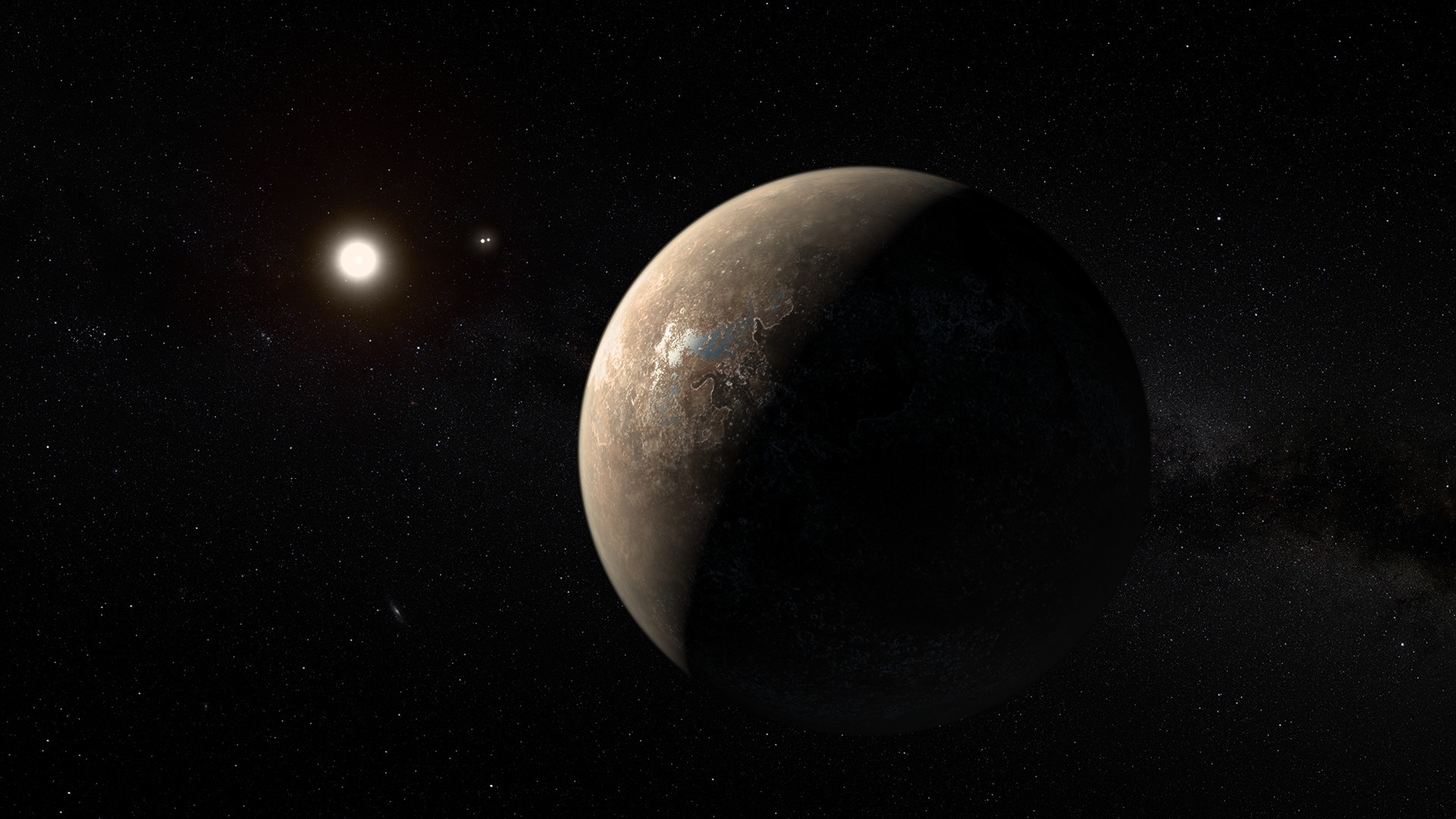
Let’s do couple more rounds before we crown the champion in this AI showdown. Now, I recently needed an interstellar photon sail for my review of Robert Zubrin’s The Case for Space. Such pictures are actually quite difficult to find in the public domain—so, I turned to ChatGPT:

Beautiful! That’s a proper light-sail, without too much weirdness. The lighting angles on the planet and the ship even agree with each other. I asked for a depiction of a particular type of spacecraft around a particular kind of planet, and I got precisely what I asked for. Now, what about Midjourney?


I think the “sail” concept got lost in translation somewhere. On the other hand, the planet in ChatGPT’s take was a boring green sphere, but these are beautiful—mountains, clouds, and all.
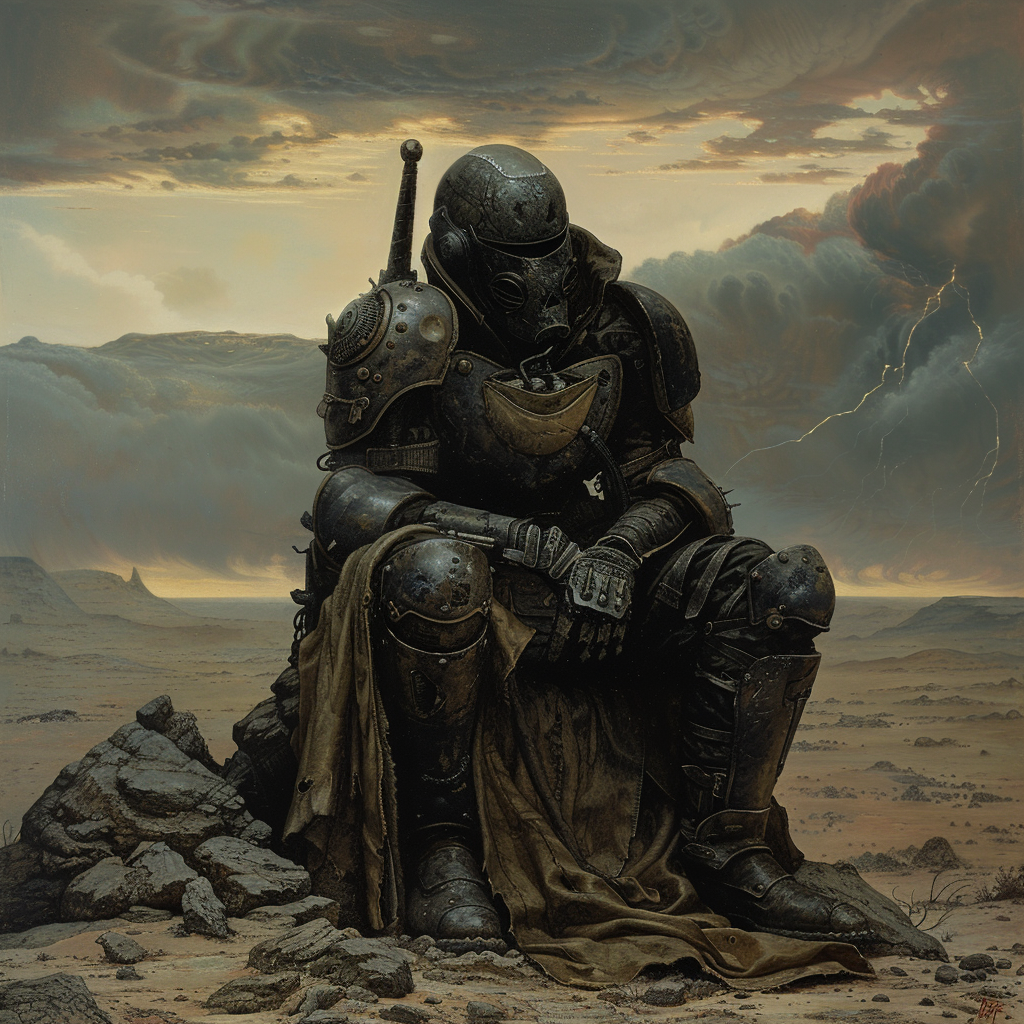
Last one. The prompt for ChatGPT: “Generate a warrior of the wasteland.”

By contrast, here’s how Midjourney interprets “warrior of the wasteland”:


Yes. This, right here, is what the French call “la bonne merde.” Look at those tattered rags! Those clouds! That armor rusted and dented by years of conflict! AI may have no imagination, but this certainly fires up mine.
So… we’ve seen a lot from Midjourney, and from ChatGPT. Who put in the stronger showing? It’s hard to say. Both can do some amazing stuff, with the right prompting, and they seem to have markedly different strengths. ChatGPT is better about giving you what you ask for; Midjourney goes in more interesting directions, with flair. I see myself using both of them in different contexts. Splashy, artsy cover photo? Midjourney. Anything to do with text or infographics? ChatGPT will at least make something legible.
Nevertheless, when it comes to the overall prize, I must award it to Midjourney. Crazy and beautiful beats polished but boring, any day of the week. Only one of these AI giants can create something truly memorable—and as it happens, it’s the cheaper subscription.

Do you agree with my choice? Did you find the Midjourney generations too messy, and prefer the ChatGPT ones? Or do you have another AI image maker you like better than either of them? Drop a comment below—I’d be curious to hear your thoughts.
And as always, if this is your first time on my site, be sure to subscribe! You won’t want to miss my unique mix of space lore, sci-fi reviews, and AI shenanigans. Lots more in the pipeline now that I’m back from hiatus.
I will catch you all next week!
- As a rule, I use AI for the kinds of things where I used to rely on stock photos or the dregs of Creative Commons. It is not replacing work I would have otherwise paid people for. I put my money where my mouth is: just for Pathfinders, I have spent more than $4,000 on human cover artists. ↩︎
- Conclusive proof that this product was made by and for nerds. ↩︎
Discover more from Let's Get Off This Rock Already!
Subscribe to get the latest posts sent to your email.















Leave a Reply