It was on October 7, 1959, that the dark side of the Moon finally came into the light. Mind you, it was never “dark” in a literal sense; all parts of the Moon undergo a complete day/night cycle, with the far or “dark” side being lit when the near one is in shadow, and vice versa. But in terms of human knowledge, it could hardly have been darker. The Moon, locked by tidal forces, always keeps the same face turned to Earth, so the other side went through history unseen by mortal eyes—the ultimate terra incognita. Only at the dawn of the Space Age could we gain any idea what was out there. In today’s post we will discuss the pioneering spacecraft that unlocked a whole new side to our nearest celestial neighbor: the Soviet space probe Luna 3.

A head start in the Space Race
Luna 3 went up only two years after the first artificial satellite, Sputnik 1, and the Soviets were still very much ahead of their American rivals. November of 1957 had seen them launch a dog named Laika aboard Sputnik 2; in May 1958, they sent up the instrument-laden Sputnik 3, by far the heaviest spacecraft yet put into orbit, and in early 1959 their probe Luna 1 flew near1 the Moon, ultimately escaping the Earth’s gravitational influence altogether. Next, in September, Luna 2 achieved a deliberate crash into the lunar surface. It was the first human-made object to touch another world.
During the same period of time, the United States managed to send up a larger number of much smaller spacecraft. The Vanguard satellite, for instance, was the size of a grapefruit. And when it came to lunar exploration, NASA was badly behind—in 12 attempted lunar missions between 1958 and 1963, there was one success, Pioneer 4, which achieved a distant flyby in between Luna 1 and Luna 2. Ultimately the US would catch up to the Soviets, and even beat them to a manned landing, but that remained far in the future. In the late 1950s, the Moon was red.

Mstislav Keldysh charts a course around the Moon
The third Luna mission was of considerably greater complexity than its two predecessors. Instead of slamming directly into the Moon, Luna 3 was to fly a carefully plotted trajectory around its far side and back, performing the world’s first gravity assist. Gravity assists change speed and/or direction by stealing energy from another object: as a spacecraft falls towards a planet, pulled by the force of gravity, it also exerts on the planet a (very small) gravitational pull of its own. The result is a kind of collision, even though the spacecraft never physically hits anything. By the time it climbs back out of the gravity well, it is traveling faster (or slower) than it was before the encounter, and the planet is moving slightly slower (or faster). Technically, Luna 3’s flyby of the Moon changed the Moon’s orbit, though the difference would be far too small to measure.
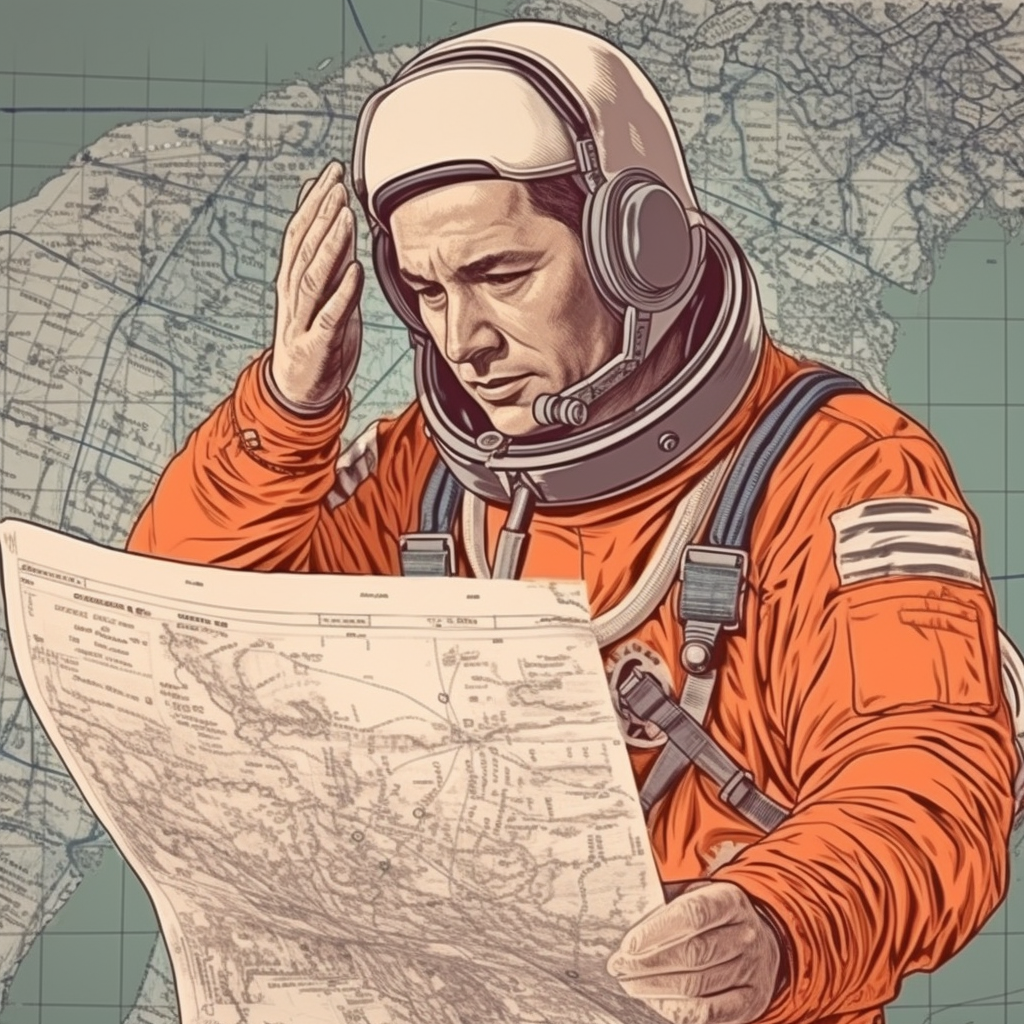
Gravity assists have been used successfully on numerous spaceflights, including the Voyager probes and the New Horizons mission to Pluto. An “orbital slingshot” was also the basis for a recent movie. But in 1959, such a maneuver was just a theory, proposed in a handful of obscure research papers. To put it into practice required formidable powers of calculation. This task fell to Mstislav Keldysh, professor at the Steklov Institute of Mathematics, and one of the guiding brains behind the early Soviet space program.

Keldysh and his colleagues had already devised the theoretical basis for Sputnik 1. But now, instead of a straightforward circuit around the globe, he had to figure out the behavior of an object that flew at high speed out from Earth, passed over the Moon’s far side, and then plummeted home. One constraint was that Luna 3 had to overfly the northern hemisphere on its way back, so that it could broadcast results to receiver stations in the Soviet Union. There was little room for error: a mistake in the calculations might send the craft smashing into the lunar surface, or hurtling into deep space before it could return much data.

The final flight path was akin to a lopsided figure-8. Luna 3 would embark from Earth at an angle, its orbit tilted slightly downward2 from the plane of Earth’s equator, so that it came up on the Moon from below. When it got close enough, the gravitational pull of the Moon would exceed that of the more distant Earth; this pull would carry Luna 3 “upward,” south to north across the far side, enabling the survey of terrain features there. Then, Luna 3’s inertia would carry it out of the Moon’s gravity well and back into Earth orbit. Thanks to the encounter with the Moon, though, the return trip would be much more steeply inclined than the outbound flight, passing over the Earth’s north pole—and by extension, the Soviet Union.
That was the plan. What remained to be seen was whether Soviet rocketry could pull it off.
The Luna 3 spacecraft
Luna 3 was quite slim as far as space probes go, massing just 280 kilograms, or about as much as a lightweight motorcycle. It had a pressurized hull and a suite of solar panels to provide electricity. Six radio antennae maintained communications with Earth, though contact of any kind would be impossible while Luna 3 was flying over the lunar far side. Most of the cameras were mounted internally, gazing out through a porthole, while photometric sensors on the outside tracked the Sun and the Moon, providing a useful reference frame for three-axis stabilization. Previous spacecraft had only stabilized by spinning around on one axis—not ideal for taking pictures.

Actually capturing images and transmitting them home was trickier than you might think. Live photos from space were far beyond the technology of the late 1950s. Instead, Luna 3’s imaging system used a complex, painstakingly laborious process straight out of a Rube Goldberg machine. At the designated time, two cameras would alternate taking pictures, capturing the far side of the Moon on radiation-resistant 35-mm film3. The film was then physically transferred to an onboard processing unit, where it was dried and developed just as it would have been in a photographer’s darkroom on Earth. A scanner took the developed film and ran over it line by line. The final output was a modulated signal, corresponding to light and dark regions on the photograph, which could be transmitted to receiver stations in the Soviet Union.
The outbound flight
Luna 3 took off on October 4, 1959, traveling in the nose cone of a Luna 8K72 carrier rocket. Thankfully, this launch passed without any of the catastrophic mishaps that then plagued both sides of the Space Race; once the Blok-E upper stage received the shutoff command, the probe was safely on its way, outbound from Earth on a sixty-hour course to the Moon. Early telemetry showed a concerning rise in onboard temperatures, but reorienting the spacecraft seemed to help. Luna 3 spun around its axis to maintain a stable orientation during the cruise phase.

On October 5, a day into the flight, there was a sudden drop in signal quality. Ground control was only receiving erratic data, greatly interfering with their ability to issue commands to the spacecraft. The Jodrell Bank tracking station in Britain, which had independently monitored Luna 3 since launch, could no longer pick up any signals at all. This caused some panic in the higher levels of the Soviet space program. The chief designer, Sergei Korolev, made a special flight from Moscow to the control center in Crimea, taking personal command of the situation.
What Korolev found was that operations on the ground were badly disorganized, with poorly defined areas of responsibility between operators and considerable interference from the military. This had led to an issue with the spacecraft antennas (though my source is unclear on exactly how). Korolev straightened things up, though, and reliable communication resumed on October 6. This was just in time; Luna 3 would soon pass over the lunar south pole.
The far side revealed
At around 60-70,000 kilometers from the lunar surface, the onboard control system fired jets to stop rotation. The probe now had to make sure its cameras were pointed the right way. That was where the photometric sensors came in handy—they picked up light from the Sun, and used it to orient the craft while it panned around in search of the Moon. Once the sensors detected moonlight, Luna 3 was aligned. The Soviets had timed this mission so that the far side was almost fully illuminated; from Earth’s point of view, the near side would have presented a new moon, all but invisible in the sky.
The onboard cameras activated at 03:30 Universal Time on October 7, while Luna 3 was 63,500 kilometers from the Moon. They captured 29 pictures over a period of 40 minutes. Some images were wide-angle views, while others focused on particular areas of the surface. Once photography ended, Luna 3 automatically resumed its rotation, and it cruised back towards Earth over the lunar north pole. Only gradually did it become possible to recover images; sheer distance meant that transmission was spotty at first, improving as the probe made its return journey. The pictures that came back, though grainy and riddled with artifacts, showed the Moon as it had never, ever been seen before:

Of the 29 pictures it took, Luna 3 returned about seventeen to the eager scientists back home. Other sources claim twelve. Six were made public4. The mission was a spectacular success, trumpeted around the world by an eager press—another spectacular Soviet first in the exploration of the Moon, proving the superiority of socialist society over the capitalist West. So the Soviets claimed, at least. Scientifically, the handful of grainy photographs were a bonanza. They showed that the lunar far side was markedly different from the near side. In contrast to the near side, with its extensive seas, or maria, the far side was mostly light-colored highlands. Honoring the discoverers of the far side, the International Astronomical Union gave many features there Russian names: Mare Moscoviense (“Sea of Moscow”), plus the craters Korolev, Tsiolkovskiy, Gagarin, and others.

Signals from Luna 3 ceased on October 22. How long it remained in space after that remains unclear; the common view is that gravitational perturbations from the Moon gradually nudged it out of orbit, whereupon it burned up in Earth’s atmosphere, but it may have survived as late as 1962. Regardless of the details, though, it had quite the run. In the whole history of space exploration, stretching over sixty years and across the Solar System, few probes have opened new horizons quite like Luna 3.
I’d like to thank my wonderful readers for giving this one a view. If you haven’t yet, be sure to drop your email in that subscription box at the bottom of the page—I have many more space articles coming down the pipeline, and you won’t want to miss any!
- It had been intended to impact the surface, like Luna 2 later would, but a mistake in transmitting the flight program caused it to overshoot its target and leave Earth’s sphere of influence altogether. Luna 1 thus became the first probe to attain orbit around the Sun. ↩︎
- “Up” and “down” being relative terms in space. ↩︎
- Here’s a wild fact—this radiation-tolerant film wasn’t of Soviet manufacture. They had actually collected it from American spy balloons, which had been shot down while overflying the Soviet Union. ↩︎
- One can assume the others showed evidence of alien activity, and thus remained classified. ↩︎
Discover more from Let's Get Off This Rock Already!
Subscribe to get the latest posts sent to your email.