
Today we continue our Star Trek adventures with the ninth entry in the series. Picard and crew are back, along with their snazzy new spaceship, the Enterprise-E, that was specially designed for the big screen. This is one of the odd-numbered Star Trek movies, with a reputation to suit; fans generally view it as mediocre, at best, and as a snoozefest, at worst. I actually think it has its charms. Let me tell you why Star Trek: Insurrection deserves to be remembered as a good Trek film, if not a great one.

Insurrection begins on a quiet, peaceful, agrarian planet. Extremely quiet, extremely peaceful, extremely agrarian. Happy people1 tend to their farms, bake bread, and cart wheelbarrows through picture-perfect village streets, while children play in the hay and giggling schoolgirls braid each other’s hair. These are the Ba’ku; there are just 600 of them on the entire world, living in this one village—and Federation researchers, hidden in a cloaked base nearby, are closely watching them.

Meanwhile, the Enterprise-E is conducting diplomatic formalities with a race that has recently achieved warp flight. Picard misses the days when he could straightforwardly explore; now, he’s involved in politics, tasked by Starfleet with recruiting new species to energize the war-weary Federation. During the dinner reception, he gets an urgent message from Admiral Dougherty (Anthony Zerbe) of Starfleet Command. Data, who had been assisting with the Ba’ku project, has seemingly gone rogue, taking the entire research team hostage. Captain Picard sends the Enterprise to investigate.

When our heroes arrive at the planet, they discover that the Ba’ku are more than meets the eye. Far from a primitive species, they’re actually former space travelers, the heirs to an advanced civilization, who have rejected technology in favor of a simple lifestyle. They settled on this world 300 years ago, hoping to remain hidden from the rest of the galaxy. Now, their idyll may be at an end. Admiral Dougherty is secretly collaborating with the Son’a, a species of slavers and drug suppliers, to evict the Ba’ku from their home—and that was why Data went rogue.
Why would the supposedly peaceful, enlightened Federation ever relocate these people? Why are they working with the Son’a? The answer lies in the planet’s rings, which generate unique radiation that heals illnesses and reverses aging. Many of the Ba’ku are centuries old. All of them are in perfect physical condition. The entire planet is a fountain of youth, and the Federation—which at this point is fighting the Dominion War—could use its power to save countless billions of lives. But they’re reliant on the Son’a to harvest this radiation, using a method that would render the world uninhabitable. Thus, relocation. Because Admiral Dougherty is no monster, he aims to move the Ba’ku as humanely as possible.

This is where we get the “insurrection” in “Star Trek: Insurrection.” Picard and his crew believe in the Federation’s founding principles of non-interference, and they won’t stand for the eviction of an innocent society, no matter what the benefits might be. They’re joining Data, and going rogue. While Riker leads the Enterprise away from the Son’a battle fleet, trying to alert the Federation populace to this abuse of human (alien) rights, Picard leads a guerrilla war on the surface, defending the unarmed Ba’ku from abduction.

The script for Insurrection is the work of Michael Piller, a veteran of Star Trek: The Next Generation, Deep Space Nine, and Voyager. This was his first venture into film; it’s not surprising that this movie feels like an extension of the television series, much more so than the other TNG films. We have a moral dilemma, we have high-minded idealism, we have a plot with fairly small stakes—the fate of 600 colonists—rather than the grand “save the Earth from assimilation” premise of the last movie. It can feel a little small, by comparison. The tone is certainly lighter, with a surprising amount of humor and banter. But is that a bad thing?
Before I sat down and watched Insurrection for this review, I hadn’t seen it in almost two decades. My assumption was that it was a bad film, which is the conventional wisdom among Trekkies, who usually rank this one in the bottom half. But having watched it again, I really don’t think so. Insurrection only suffers by coming after the superb Star Trek: First Contact. Taken on its own, it’s a good movie, reasonably paced (just a hare over 90 minutes in runtime) and richly adorned with action, character development, and good old-fashioned Star Trek philosophizing.

Jonathan Frakes directed this film, just like the last one. It shows! He’s remarkably talented, with skill in the director’s chair to complement his on-screen acting chops. Scenes are effective and well-framed. The action sequences (mostly) don’t drag. Towards the end we see a superb space battle against the Son’a, showing off the Enterprise as a true Federation dreadnought. It helps that Insurrection has one of the best scores of any Star Trek movie, composed by the Jerry Goldsmith, who masterfully provides us the serene Ba’ku theme as well as some truly grand action music.
A few subplots do a lot to develop the TNG cast. There’s a romance between Picard and a Ba’ku woman named Anij (Donna Murphy); Data, the android, develops a friendship with a Ba’ku boy, from whom he learns how to relax and goof off; Riker and Troi rekindle their old relationship—which, thanks to some excellent acting by Jonathan Frakes and Marina Sirtis, is a joy to watch. Insurrection gives its characters space to breathe, a nice change of pace after the relentlessly action-packed First Contact.

The Son’a make good villains, too. Some of the better ones2 we’ve seen in Star Trek on the big screen. To say why will spoil a major twist, so I’m placing it behind a spoiler shield, below:
HERE BE SPOILERS
The Son’a are the same race as the Ba’ku. A hundred years ago there was a schism in the Ba’ku community, when a faction of their youth grew tired of slow, stultifying village life, and wanted to pursue advanced technology and integration with the rest of the galaxy. They lost the power struggle, going into exile offworld. This faction, led by Ru’afo (F. Murray Abraham), became the Son’a Solidarity, enslaving two primitive civilizations to bolster their meager numbers.
There’s a certain opulence about them, a taste for luxury quite at odds with the Federation ethos. Their interiors burst with aesthetic flourishes, their clothes are of flamboyant golden silks, and they’re always surrounded by servant girls in skintight spandex. Even the Son’a bridge boasts a couch with pillows for Ru’afo to sit on. It calls to mind Supreme Leader Snoke and his golden slippers, from the Star Wars sequel trilogy. I like this approach, myself. The Son’a as distinctive as they are decadent.

Unlike the Ba’ku, the Son’a have suffered the normal effects of aging. They’ve extended their lifespans through various technological means, and as a consequence, they are a hideous patchwork of surgeries, with stretched-out faces and internal organs that just barely keep functioning. In one nauseating scene, Ru’afo’s leathery forehead splits open during a moment of rage. They’re running out of time to harvest the planet’s radiation and restore their youth before they start dropping dead. Unlike Admiral Dougherty, they don’t care if they have to kill the Ba’ku to do so. Indeed, Ru’afo has a long memory, and he’s out for revenge…
I don’t much like the Ba’ku. They’re just too perfect. Too pure. A theme-park version of an imagined agrarian past, when people lived slower, happier lives, and the moral corruptions of modernity had yet to take root. Their faux-Amish lifestyle is only possible because they live on the Planet of Youth; without the radiation to sustain them, half their children would die before the age of ten, and they would be beset by smallpox, bubonic plague, and leprosy, just like premodern populations on Earth. It’s also a little rich when the Ba’ku refuse to pick up arms in their own defense, forcing Picard and his crew to do all the work. Ungrateful!

My other issue with Insurrection is that there’s supposed to be a war going on. Chronologically, it takes place during the later seasons of Deep Space Nine, when the Federation is embroiled in an existential war against the invading Dominion from the Gamma Quadrant. We see and hear very little of that. The Enterprise-E, supposedly the most powerful ship in Starfleet, starts the film on a diplomatic mission to some backwater alien race, instead of slugging it out with the Dominion on the front lines. Riker mentions in passing that the Son’a manufacture something called Ketracel-white, a reference which will probably fly over the head of a casual viewer. The drug Ketracel-white is, in DS9, exclusively consumed by the Dominion’s bio-engineered shock troops, which means the Son’a—with whom Starfleet collaborates—are actively supplying the Federation’s enemies. The issue is never explored further.

On the other hand—in one scene, Picard and Worf are in a shuttle, chasing down Data, flying another shuttle. Data’s memory circuits are fried and he doesn’t remember who he is. How to reach him? Well, as we’ll recall from the show, Data was always musically inclined—and apparently, he’s been practicing for a role in the opera H.M.S. Pinafore. So, Picard sings him the lyrics. The result: two glorious minutes of Picard, Data, and Worf singing the lyrics to a 19th-century British musical, while flying their 24th-century shuttlecraft far above the clouds of an alien world. What’s not to love about that?
Star Trek: Insurrection may be a tad wobbly, but it really has its moments. A recommended watch.
Rating: 7/10.

Other Star Trek offerings on this blog:
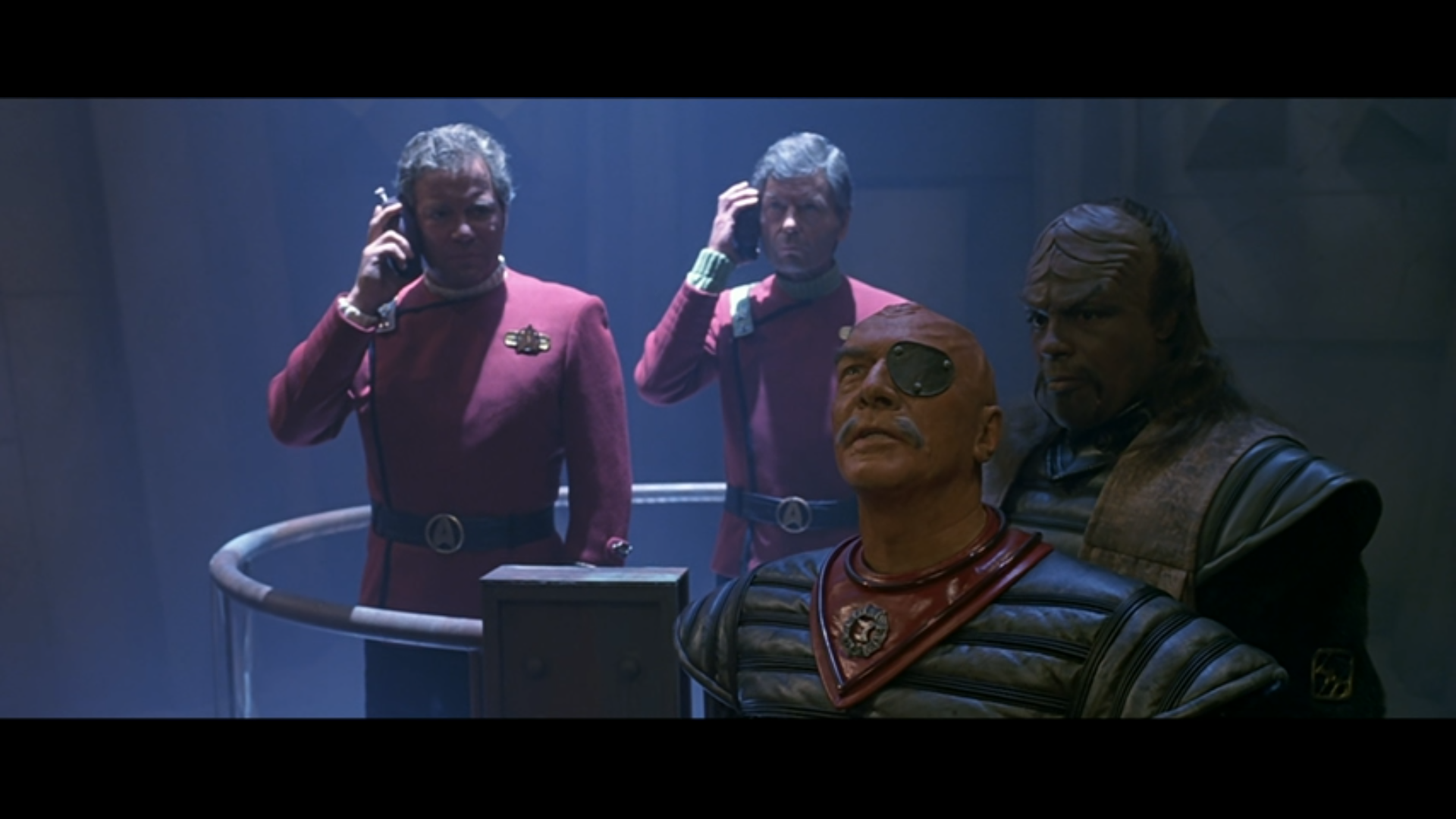
Star Trek VI: The Undiscovered Country
- Literally all of them are white people. Not the most diverse planet in the galaxy! ↩︎
- The competition is poor on this front. Consider that even some of the strongest Star Trek movies have had weak antagonists: Beyond featured the underdeveloped Krall, the 2009 reboot had Eric Bana play a lame Romulan miner, and The Voyage Home didn’t have a villain at all. That’s to say nothing of Shinzon, Sybok, or the reboot Khan… ↩︎
Discover more from Let's Get Off This Rock Already!
Subscribe to get the latest posts sent to your email.





















Leave a Reply