
Back in February I handed down the definitive ranking of all the planets in our Solar System. Today, I’m going to finish the job with a corresponding ranking of the Solar System’s moons—rich and varied worlds in their own right, some larger than the smallest planets. This will not be an exhaustive list. Jupiter alone has at least 97 moons, while Saturn boasts more than 200. Even asteroids have moons! So for our purposes today, we will include only the seven largest, Triton and up, plus other interesting moons as I see fit. As with the last time, the criterion for my ranking will be the only one that matters: how much this author likes them.

16. Phobos and Deimos.

It’s a shame the planets closest to us didn’t get much in the way of moons. Venus has no moons at all; Mars has a pair of captured asteroids, of such pitiful size that they weren’t discovered until 1877. Phobos, orbiting closer to Mars, measures just 26 kilometers on its longest axis, while Deimos measures a scant 16 kilometers. Both of them are unremarkable space boulders. Aesthetically, they aren’t much to look at, and in practical terms, their only value is as a staging ground for a future Mars colony. I’m not a fan.
15. Mimas.


Yes, yes, it’s the Death Star moon. That’s pretty much all it has going for it. Mimas is an extremely small moon of Saturn with an extremely large crater, which has given it more attention than it deserves. I frankly find it garish-looking. The size of the craters relative to its disk makes it look bumpy and uneven. Worse, it isn’t even particularly spherical—photos from different angles (see above) show that it has a pronounced egg shape.
14. Titania, et al.

The four largest moons of Uranus (Titania, Oberon, Ariel, and Umbriel) are all pretty much interchangeable. They’re just icy, rocky balls, pockmarked by craters, crisscrossed by ravines from long-dead geologic activity. Snooze. Some of them are at least kind of pretty to look at, if you squint.
13. Tethys, et al.

Just like Uranus, Saturn has its own parade of lookalikes. Rhea, Dione, and Tethys are all kind of… same-y. Tethys has one distinction: it was the setting for a cheesy B-movie about a killer robot. It is that point, and that point alone, which elevates the Saturn Crew (Rhea, Dione, and Tethys) above the Uranus Crew (Titania, Oberon, Ariel, and Umbriel) in this ranking of moons. My methods are nothing if not scientific.
12. Pan.

Pan is wacky. It may be a small, lumpy rock, but it’s a damn sight more interesting than most small, lumpy rocks. Because it orbits within Saturn’s A Ring, it has accumulated millions of years’ worth of debris in a ridge around its equator, turning it into something like a giant ravioli. Pretty neat!
11. Hyperion.

Hyperion is one of the outer, irregular moons of Saturn. Like Pan, it dares to be interesting, instead of settling for a mediocre existence as just another rock. Hyperion is a gigantic bath sponge, pockmarked with holes and most likely porous. Hyperion also gets points for its awesome name, which it shares with a classic science fiction novel by Dan Simmons—a novel I have waited far too long to read. There will be a review, one day.
10. Iapetus.

Iapetus, also a satellite of Saturn, is distinguished from Tethys et al. by being the Two-Face of moons. One side is a field of white ice almost as bright as Europa; the other side, an expanse of dark brown rock. It is believed that this unusual coloration is the result of a feedback loop—deposition of dark material on one hemisphere caused it to absorb more sunlight, which made it warmer, which caused more ice to evaporate, which made it darker. The end result is one striking moon, worthy of the #10 slot on this list.
9. Miranda.


Miranda is the jigsaw puzzle of the Outer Solar System. It looks as if something broke it apart, rearranged the pieces, and then haphazardly glued it back together. It certainly threw scientists for a loop back in 1986, when Voyager 2 explored Uranus and its moons. How this actually happened is still not understood, despite decades of speculation—and the mystery deserves a blog post of its own. Suffice it to say, for today’s ranking, that Miranda is a charming little oddball.
8. Io.

Io is easily the most colorful moon on this list! Unfortunately, the color is that of a moldy pizza—which, while striking, isn’t pretty, per se. Io also contrasts with the rest of the Outer Solar System moons by being a rocky, volcanic world, rather than a ball of ice. It is erupting more or less all the time. All the sulfur it spews out forms a major component of Jupiter’s magnetosphere. Where does it get this furious energy? From the tidal action of Jupiter’s gravity, crushing it like a vise, squeezing ever harder with each orbit, constantly churning the molten inferno of its interior. Metal.
7. Callisto.

Callisto is the outermost of Jupiter’s major moons, and the only one to be outside its radiation belts. That makes it a strong candidate for future human colonization; it also means that it has been influenced very little by tidal forces, unlike its stormier siblings Io and Europa. As a result, Callisto has one of the oldest surfaces in the Solar System. Just craters… and craters… and craters. That gives it a certain stark beauty, with the alternating light and dark of its ancient highlands and bright impact basins—and, since Callisto is much prettier than Io, I give it the #7 spot.
6. Triton.


Triton used to be a Kuiper Belt object like Pluto, until it was captured by Neptune’s gravity. It now occupies a distant retrograde orbit, circling Neptune at a much higher inclination than one would expect for a large moon—and in the wrong direction, to boot. None of Neptune’s other moons are anything to write home about, but Triton’s a real marvel. It boasts volcanoes, spewing plumes of soot skyward, which are then carried over the moon’s surface by its tenuous atmosphere. Large regions of enigmatic “cantaloupe terrain” have been formed by periodic thawing and freezing. Triton’s surface is so dynamic that hardly a single crater can be found; it constantly reshapes and resurfaces itself. It’s also very, very cold—a mere 38 degrees above absolute zero.
Dynamic, full of surprises, literally and figuratively cool. We’re getting into the big leagues of Solar System moons, now.
5. Enceladus.


Enceladus is very pretty—a smooth white billiard ball, crisscrossed by a few tasteful fissures, contrasting older, cratered regions with vast plains of fresh ice. Aesthetics alone would be enough to place it among the best moons in the Solar System. But it’s also one of the more promising candidates for extraterrestrial life, second only to Europa. The south pole boasts a major subsurface ocean; briny water, heated by tidal forces, seeps through cracks to the surface and then dissipates into space via spectacular geysers. Might we find alien microbes in those geysers? Only further exploration can tell…
4. Ganymede.

Ganymede—the cupbearer to Jupiter, in Roman mythology, and in astronomy, the king of Jupiter’s moons. It is larger than the planet Mercury; it is much larger than Earth’s Moon. Like Europa, it hosts a considerable subsurface ocean, perhaps the largest in the Solar System. Its icy surface is a patchwork of ancient highlands and younger ice floes, complete with a few striking ray craters. Grander than Enceladus, prettier than Callisto, it carves out for itself the #4 slot in this ranking.
3. Europa.


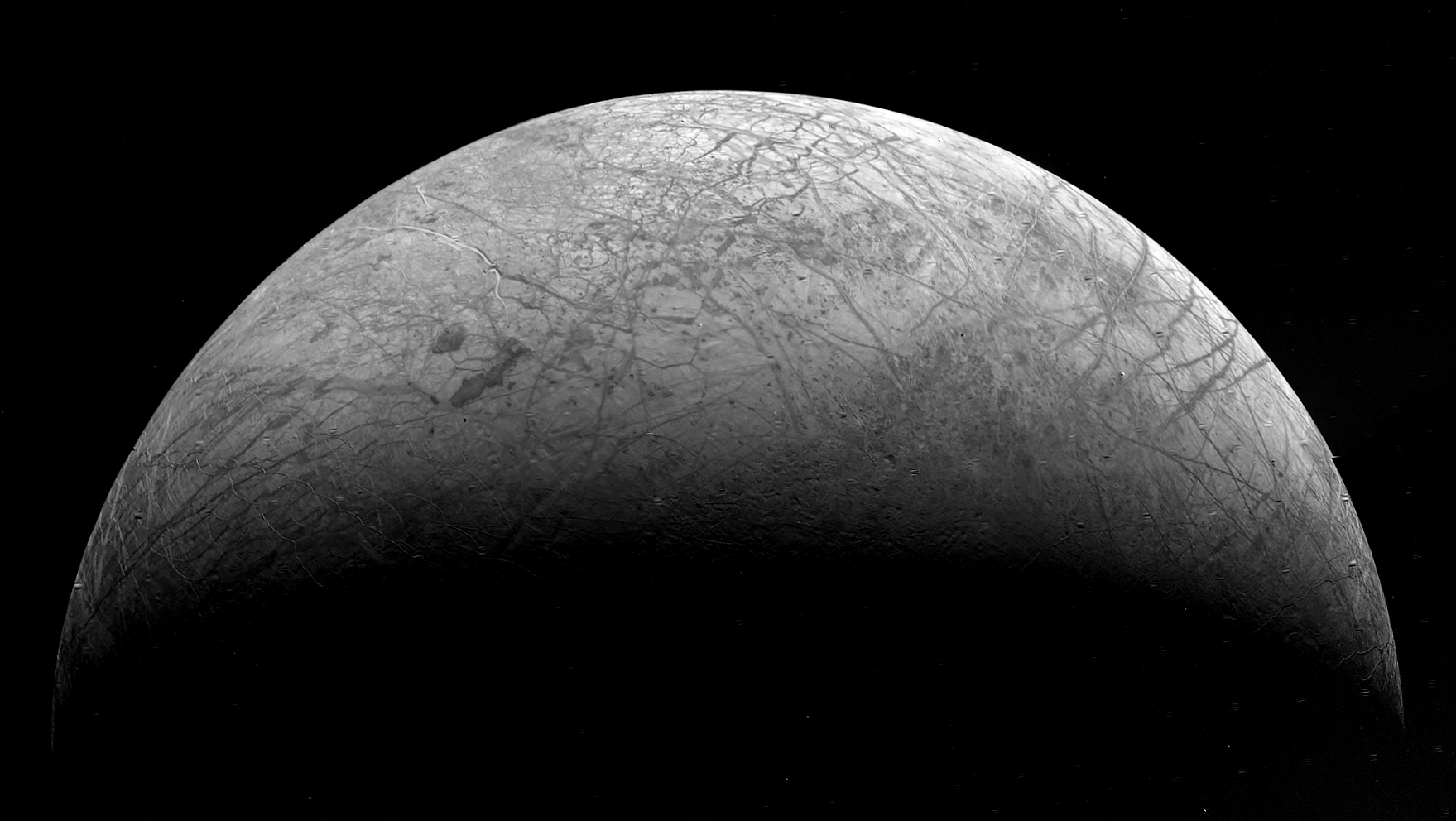
Europa orbits Jupiter between Io and Ganymede. It is an ice ball, like Enceladus, except bigger and icier. It is also one of the likeliest abodes for life beyond Earth. Its icy shell conceals a globe-spanning ocean tens of kilometers in depth, perhaps heated at the bottom by tidal vents—vents much like those in the oceans of our own planet, where whole communities of living things flourish without a glimpse of sunlight. NASA’s flagship Europa Clipper mission is headed there as we speak, seeking to probe the mysteries under the ice…
Europa beats almost all the others on this list, for its scientific potential alone. Also, damn, just look at it! Gorgeous, gorgeous, gorgeous. Red organic streaks on blue ice make an enchanting combination.
2. Titan.


Saturn’s largest moon, Titan, is without a doubt the strangest place on this list. It is the only moon in the Solar System with a substantial atmosphere. Its atmosphere is so substantial, in fact, that it blocks the surface from view, shrouding all of Titan beneath a haze of hydrocarbons. The nitrogen air on that world is so thick, a human would be able to fly with wings and a space suit. And it gets weirder—Titan is so cold that water ice takes the place of solid rock, while methane takes the place of water. There are methane clouds and methane seas; methane rivers and methane rain and methane mud. Nowhere else that we know of boasts liquid on the surface. It’s a bizarre parallel of Earth, chilled to frigid temperatures and transplanted to the Outer Solar System.
For its sheer complexity, weirdness, and scientific interest, I award Titan a coveted title: my second-favorite moon.
1. The Moon.


Once again I show my blatant Earth bias—or in this case, bias towards Earth’s moon. Sure, it doesn’t have the active volcanism of Io, or the pristine icy plains of Enceladus, or the methane lakes of Titan. But it’s our Moon. It’s right up there in the sky! Humans have walked there! All you need is a telescope, and you can treat yourself to stunning views of terrain quite unlike anything on Earth—so many craters and lava seas, dry and airless, a dusty mausoleum left over from the early ages of the Solar System. Stark shadows; regolith like powdered snow. Eerie, otherworldly, but peaceful. I have dreamt many dreams about leaping across those trackless wilds. It’s taken a long time, but fairly soon, now, people will walk there again.
And the title of Best Moon goes to—the Moon.
Thanks for reading this one, folks! We’ve sorted out, once and for all, which moons are superior. Do you have a different interpretation? Feel free to drop a comment below, if so. And of course, if this is your first time stopping by this site, go ahead and enter your email in the subscription box—I post no shortage of high-quality space content, multiple times each week, and you won’t want to miss it.
I’ll catch you all next time!
Discover more from Let's Get Off This Rock Already!
Subscribe to get the latest posts sent to your email.


















Leave a Reply