When we last saw the Next Generation crew on the big screen, they took over from Captain Kirk with an awkward, confused, ultimately anticlimactic passing of the torch. Not the film debut they deserved. Thankfully, the next movie got things on the right track again—and boy is it a movie. It’s got action! It’s got time travel! It’s got Captain Picard slaughtering Borg drones with a machine gun! Today’s review: Star Trek: First Contact.

First Contact came out in November of 1996, almost exactly two years after the previous film. A lot had changed since then. Star Trek: The Next Generation was long gone from the airwaves; Deep Space Nine was building to the culmination of its Dominion War story arc; Voyager meandered around all kinds of freaky planets in the Delta Quadrant. Between two concurrent TV shows and a film series, Star Trek was in its boom era, boasting snazzy new Starfleet uniforms, darker stories, and above all, a fictional universe grand in scope, sprawling and interconnected in a way few franchises could match.
The time seemed right for an ambitious Star Trek blockbuster, giving Picard and his crew a chance to shine like never before. Series heavyweights Brannon Braga and Ronald D. Moore wrote the script. Jonathan Frakes directed, while pulling double duty on the set as Commander William Riker. First Contact‘s budget, $45 million, was the largest of any Star Trek movie to date1. Our heroes got new looks: their uniforms were upgraded to the Deep Space Nine standard, sporting a more militaristic purple-on-black. Geordi LaForge traded in his bulky visor for cybernetic contact lenses. The Enterprise-D had met an inglorious end in Generations, crashing on Veridian III after a scuffle with a Klingon Bird-of-Prey, so this film would introduce its sleek replacement: the Enterprise-E.


Star Trek: First Contact opens with a dream sequence. Picard is remembering his time in thrall to his greatest nemesis from the TV show: the Borg. Six years ago, they forcibly abducted and assimilated him, turning the principled captain into Locutus of Borg—a mouthpiece for Collective, stripped of any individuality, turned against his own friends and ship. He was rescued, but scars remain. Picard still has a faint link to the Borg Collective. He knows from his dreams that they’re coming back—and so does Starfleet Command, whose long-range scans have just detected an incoming cube, bound for Earth.

What follows is one of the most impressive space battles ever witnessed in the history of Star Trek. Starfleet meets the Borg threat with nearly everything it’s got, marking the debut of a whole fleet of warships never before seen onscreen. Also in the fight is the Defiant from Deep Space Nine, a nimble little craft armed to the teeth with phase cannons, purpose-built to take on the Borg. But even with all that firepower, the Federation gets its ass kicked by a single Borg cube. Hopelessly outgunned, they’re on the verge of losing the battle, and Earth—until the Enterprise-E swoops in to save the day.

With Picard’s inside knowledge, Starfleet makes short work of the cube. But the Borg’s collective intelligence is a tricky bastard. As their main ship is destroyed, they launch a smaller vessel, a sphere, which dives towards Earth—while also opening a temporal portal. The Enterprise chases it back in time to April 4, 2063. That’s one day before the historic first flight of inventor Zefram Cochrane (played by James Cromwell), whose use of a warp drive is supposed to draw the attention of a Vulcan survey ship. The Borg’s true plan becomes clear: defeat the Federation in the present, by preventing it from forming in the past. Picard and the crew of the Enterprise are the only ones who can stop them.
If that sounds like a ridiculous plot, it is. But keep in mind that just one movie ago, Picard and Kirk foiled a mad scientist’s 80-year plan to reach heaven by blowing up stars; three movies ago, the Enterprise got hijacked by Spock’s zealot half-brother and flew to the center of the galaxy to find God; four movies ago, Kirk and company traveled back to 1980s San Francisco to steal some whales from an aquarium, which they needed to satisfy an alien probe’s world-wrecking attempt at saying “hello.” Ridiculous plots are the bread and butter of Star Trek. Sometimes, they can work quite well.

First Contact really has two separate plot lines, as the characters are soon separated and kept out of communication with each other. Only near the end do they converge again. Down on Earth, in a fortified compound in post-apocalyptic2 Bozeman, Montana, Riker leads an away team with Chief Engineer Geordi LaForge and Counselor Troi. Their job is to help Zefram Cochrane repair his ship, the Phoenix, and make first contact with the Vulcans. In orbit, meanwhile, Picard, Data, Worf, and Dr. Crusher defend the Enterprise against the Borg, who are attempting to take over the ship and assimilate its crew. Complicating matters is the presence of Lily Sloane (Alfre Woodard), a friend of Zefram’s who was brought aboard for medical treatment; she is a 21st-century woman plunged far out of her depth.

Credit to the writers, here—they pack a lot into this film’s runtime, and this story proceeds at a brisk pace. There isn’t a huge amount of downtime between the more action-packed sequences. Even so, we get a satisfying amount of character development, at least for some of the cast. Data gets plenty of attention; as a fully synthetic being, he has long wished to be more human, so what happens when he’s captured by a cyborg race? First Contact has an interesting angle on historical memory, too. It contrasts a myth—Zefram Cochrane, the heroic inventor of warp travel—with a man—Zefram Cochrane, the crude, boorish alcoholic, who invented the warp drive because he wanted to get rich. At one point Cochrane gets tired of all the hero worship, and runs off into the woods; Riker has to forcibly drag him back to play his assigned role in history.

Above all, Star Trek: First Contact is an examination of Jean-Luc Picard, who must face the collective intelligence that once enslaved him to its will. To say he holds a grudge is putting it mildly. Picard may normally be calm, composed, and rational, a diplomat and peacemaker at heart, embodying the highest ideals of the human race, but against the Borg, he shows a darker side. He guns down Borg drones with positive glee; he orders the Enterprise crew to suicidally hold the line, even as it becomes apparent they’re losing the fight. Picard’s hatred of the Borg turns him into a zealot, obsessed with revenge at any price. It takes his newfound friend from the past, Lily, to make him see reason.

Now, a word on the villains. These Borg aren’t quite what we saw in The Next Generation. Back then, on a TV budget, they were stiff cyborgs with chalky white skin, their civilization faceless and leaderless, more concerned with seizing technology than with assimilating other races into their hive mind. First Contact‘s Borg, by contrast, are something out of a horror film. They’re space zombies. Their skin is sickly and mottled; they march wordlessly towards their targets with a stiff, steady gait; they grow like a virus, infecting people with nanoprobes that transform them into Borg from the inside out. In one delightful scene, we see the inside of a Borg assimilation chamber, where former Enterprise crew have their limbs amputated and their eyes plucked out to make room for cybernetic enhancements.


Another thing is different about these Borg: they have a leader. We’re introduced to the Borg Queen (Alice Krige), who identifies herself as “the one who is many,” the one who “brings order to chaos.” She acts as an embodiment of the Collective, directing and coordinating the efforts of trillions of linked minds. Apparently she was there during Picard’s prior assimilation, just offscreen (a questionable retcon, if you ask me). But the writers felt that if the Borg were to be effective villains, they needed a face. They had to be… personal. And what could be more personal than Alice Krige in a cyborg catsuit, robot breasts and all, literally seducing Data into joining the Borg?

The Borg Queen is the weakest part of this movie. That’s not meant as a slight to Alice Krige, who’s stellar in the role. Conceptually, though, it was a bad idea to undercut Borg’s identity—a relentless collective mind, impossible to reason or bargain with—by giving them a supreme leader, on whom the entire Collective is dependent. They’re not so scary if you can just kill the Queen. They’re not so mysterious if said Queen spends half her time giving speeches, and the other half acting like Picard’s bitter ex-girlfriend.

Now, I think the Borg still work in First Contact. More or less. Much of that is thanks to Krige’s acting, and the chemistry she has with Data and Picard. Story-wise, there were benefits to embodying the Borg in one person. But in the long run, this spelled doom for them as credible villains, watering down what originally made them threatening. By the later seasons of Voyager they would be an utter joke. I wonder if it would have been possible to make First Contact without the Borg Queen—if there could have been a way to keep the original nature of the Borg as a truly collective civilization, vast and unknowable, a Lovecraftian horror for the Star Trek universe. My hunch is, it could have been done. Perhaps this is an opportunity for some fan fiction?
A few other points of note, before I close out this review. Star Trek: First Contact deserves credit for being one of the few Trek films to recognize that the franchise takes place in space. Thanks to the film-level budget, we’re treated to some rare sights: zero gravity, and vacuum suits. In the first sequence of its kind in Star Trek history, Picard and Worf fight Borg on the outside of the ship. It’s awesome.

Special mention also goes to the soundtrack by Jerry Goldsmith. All the Star Trek films have great scores, including the shitty films, like Nemesis and Final Frontier. Even so, the score to First Contact ranks among the very best. The hopeful notes of the main theme keep the film’s tone from getting too dark, while Goldsmith introduces a suitable leitmotif for the Borg, menacing yet tragic. Listening to it, one can almost hear the countless drones violently robbed of their former lives.

Finally, First Contact marks the true beginning of the Next Generation film series. Generations was really just a continuation of the TV show, using the same sets and uniforms—but once the crew got a new ship, the Enterprise-E, they got a new direction, too. From First Contact onward the series would be much more action-oriented. The next two outings, Insurrection and Nemesis, tried and failed to replicate this film’s success, in the mistaken belief that having Captain Picard blow more things up would make for good Star Trek.

First Contact was the peak for Picard and his crew. They at least got one solid movie, before things went downhill. Likewise, the Borg have never looked better—their subsequent3 appearances on Voyager and Enterprise returned to a TV budget, with results to show. Season 2 of The Next Generation may have introduced the Borg, but this film defined them forever. It was here that Star Trek minted its most iconic villains.

Now, is First Contact the best of the Star Trek movies? Many fans think so, but I don’t agree. There are better ones. The Borg Queen and the time travel plot are rather ridiculous, when you think about them, and while this may be an eye-popping, pulse-pounding blockbuster, it doesn’t have the operatic elegance of The Wrath of Khan, or the sophistication of The Undiscovered Country. If we must rank, I give it third. “Best of the TNG movies” is unfortunately not as impressive a title.
Still—this is a damn good film. A must-see, for old and new fans alike.
Rating: 9/10.
Other Star Trek offerings on this blog:
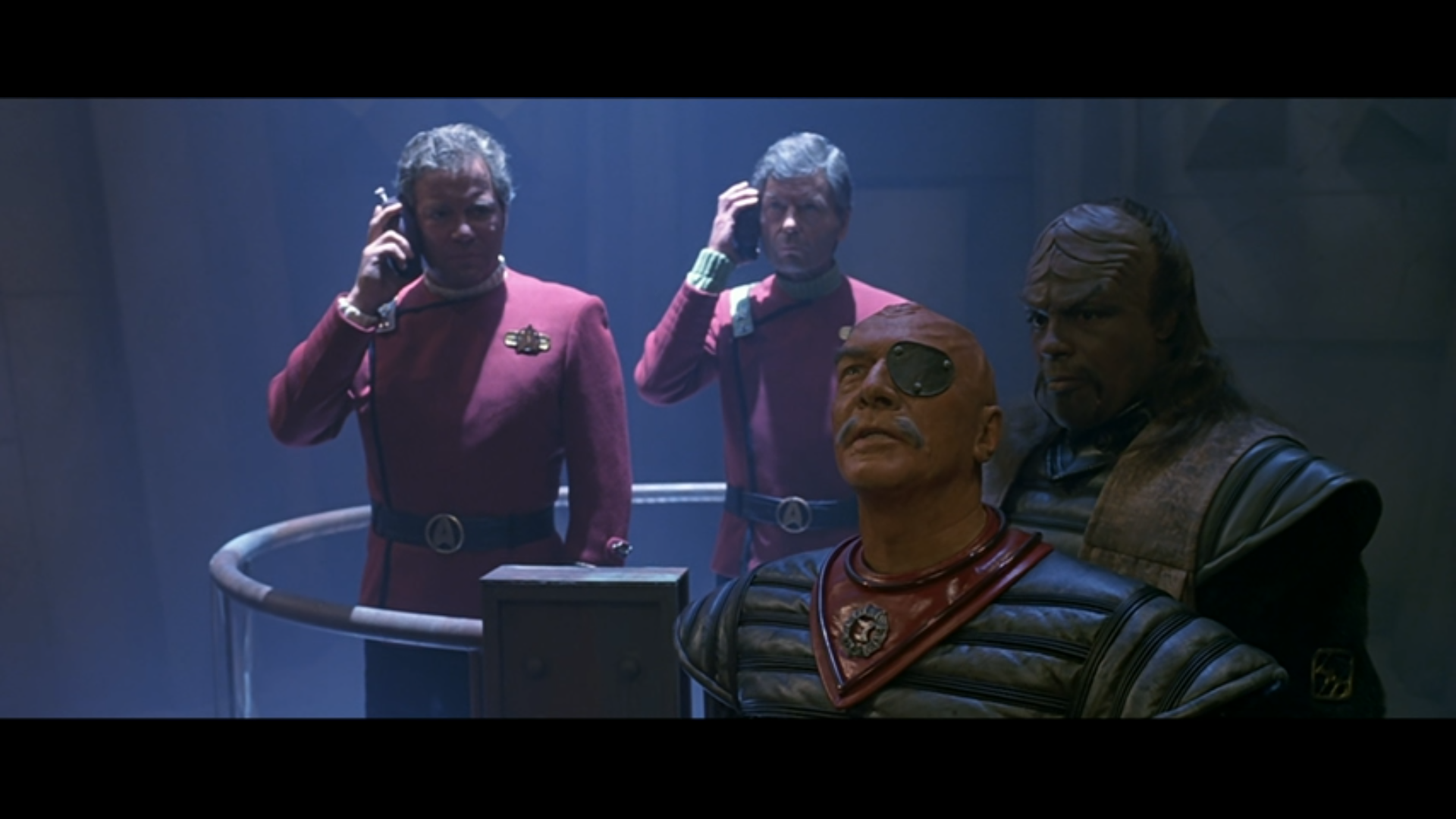
Star Trek VI: The Undiscovered Country
- Unless you adjust for inflation, in which case 1979’s Star Trek: The Motion Picture would handily beat it. ↩︎
- Canonically, 2063 is about a decade after the Third World War, which led to hundreds of millions of deaths and the partial collapse of civilization across the globe. ↩︎
- I guess the Borg also appeared in Picard and Prodigy. Whatever. I’ve never seen them. A day may come when the stubbornness of this fan fails, and he accepts that the post-2017 shows are canon—but it is not this day! ↩︎
Discover more from Let's Get Off This Rock Already!
Subscribe to get the latest posts sent to your email.