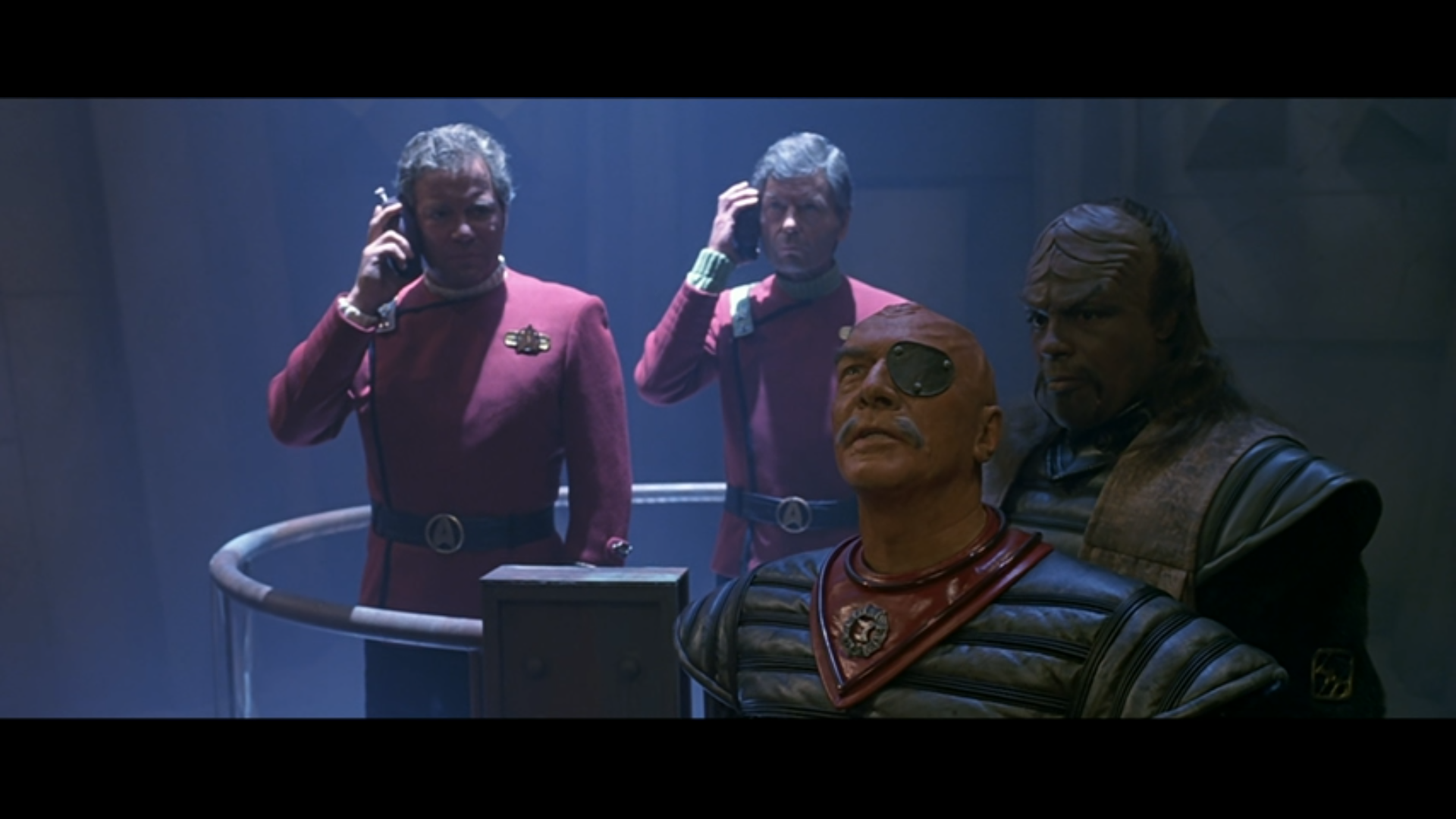
At long last, we return to the Star Trek franchise. For today’s post we’re going to follow up from my review of The Undiscovered Country with the next installment in the series. This is a deeply uneven film that attempted, with some success, to pass the baton from the Original Series crew to the cast of The Next Generation. I present you, Star Trek: Generations: the one where Kirk and Picard team up to save the day.

Generations came out in November 1994. That happened to be a hectic time for what was by then a sprawling Star Trek empire; The Next Generation had just finished its seven-season run with the series finale, “All Good Things,” in May of that year, while Deep Space Nine, TNG‘s even more ambitious successor, was starting its third season. Another spinoff, Voyager, was in production. Amid that flurry of TV work, Star Trek executive producer Rick Berman somehow found time to make a feature film. It was to be the first of a planned series involving the TNG cast, but also it would also bring back some characters from the original show, most prominently Captain Kirk, for one last sendoff. Writers Ronald D. Moore and Brannon Braga faced an unenviable task: bridging the two eras in a way that would meet fans’ sky-high expectations.

The film opens in Kirk’s time, a few years after the events of The Undiscovered Country. A new Enterprise, Enterprise-B, is heading out for its maiden voyage, with Captain Kirk (plus Chekov and Scotty) present for the occasion. Eager reporters hover all around the bridge, snapping pictures. It’s all a fine ceremony, at first, but this is Star Trek we’re talking about—space has no shortage of things that can go wrong. They soon receive a distress call from a convoy of civilian freighters. Enterprise is still missing key equipment (the torpedoes and tractor beams are supposed to be installed on Tuesday), and its fresh captain, John Harriman (Alan Ruck), is obviously out of his depth, but it’s the only ship in range1.

The stricken ships appear to be caught in some kind of rift in spacetime. While one is lost with all hands, Enterprise manages to beam aboard passengers from the other. They are refugees, El-Aurians, fleeing the destruction of their homeworld by an alien race2. TNG regular Guinan (Whoopi Goldberg) is among the survivors. Strangely, another refugee (played by Malcolm McDowell) pleads for the crew to send him back into the anomaly. There’s no time for that, of course, as Enterprise is in grave danger, and it has to get out of there before the lashing currents of energy crush it.
The situation calls for some dashing heroics. Thankfully, James T. Kirk is aboard to provide them! He crawls down to the deflector dish, flips a switch or something (there’s some technobabble explanation for it), and enables the Enterprise-B to escape, saving the lives of everyone aboard. But this does not come without sacrifice—one last lash of energy pierces the section of hull he’s in. Kirk is presumed dead.

Flash forward 78 years. We’re on the holodeck of the Enterprise-D, with Picard, Riker, Troi, and all the other TNG main cast, all dressed in their finest 18th-century naval uniforms aboard a recreation of a sailing ship. Sadly their fun is interrupted by a distress signal (again), and of course the Enterprise is the only vessel that can help out. This time the call comes from a stellar observatory. Romulans have attacked it, and the only survivor is an El-Aurian scientist, Dr. Soran, who looks suspiciously like Malcolm McDowell’s refugee from the prologue. Maybe not all is as it seems…

SPOILERS WITHIN
Dr. Soran is not a good guy. He is, in fact, the villain of this film. His grand scheme is to blow up stars with trilithium warheads, redirecting the course of the energy rift from earlier—called the Nexus—so that it snatches him up for good. Why does he want to do this? Well, the Nexus leads to a timeless dimension where all one’s desires are fulfilled, something like a secular heaven for the Star Trek universe. Guinan describes it to Picard as like “being inside joy.” In his brief time in the Nexus, Soran was reunited with the family he lost to the Borg; he has spent the intervening decades singlemindedly obsessed with going back.

The plot of this film is… a bit muddled. Soran is the main villain, but he does not pose the most immediate threat to the Enterprise crew—that would be the Duras sisters, recurring Klingons from the TV show, whom Soran has enlisted to help him. They kidnap Geordi and eventually find a way to bypass the Enterprise‘s shields; shockingly, their Bird of Prey (an obsolete scout vessel) mortally wounds the Federation flagship in a one-on-one duel, forcing an emergency crash-landing on nearby Veridian III.

Meanwhile, Picard faces Soran, who is using Veridian III as a base to launch a rocket that will destroy the local star. This will redirect the incoming Nexus and allow him to finally return to a state of bliss. He actually succeeds at this! The rocket launches, the star explodes, the Enterprise and some 200 million local aliens (whom we never see) are destroyed. But Picard is now in the Nexus, which exists outside of time. Guess who else got sucked into the Nexus?

That’s right! Kirk is back. For a bit—a whole twenty minutes, in fact. Compared to this movie’s two-hour runtime, it’s almost a cameo. Picard finds Kirk in his idyllic Montana cabin, or rather, an illusory recreation of it. The captains bond over some horseback riding3. Kirk initially wants to stay, but Picard talks him out of it; he’s hardly one to pass up a good, old-fashioned adventure. They return together to Veridian III, traveling back in time to a few minutes before Soran succeeds at his dastardly plan.
The final battle, if you could even call it that, is a fistfight on some rickety catwalks atop a desert peak. It’s just Kirk and Picard against Soran. Our heroes do come out on top, eventually, destroying Soran’s star-killing missile and sending the doctor himself falling off a cliff—but there is a price. Kirk gets crushed by a bridge4.

And that’s how Captain Kirk dies! The Captain Kirk. There’s a reason this scene literally named the trope for an undignified and anticlimactic death.
Anyway. Starfleet soon swings by to rescue the crew of the Enterprise-D, which has been pretty thoroughly damaged beyond repair. They’ll need a new ship for the next movie. Picard, for his part, buries Kirk on Veridian III, makes one final captain’s log, and rejoins his crew—so ends Star Trek: Generations.
There’s a lot to like here. The TNG cast are dynamic and charming on the screen, as always. We see a subplot about Data finally installing his emotion chip, which gives him some great character development. We also get some more insight in Picard as a person; early on, he receives news that his brother and nephew died in a fire back home on Earth, which casts a shadow over him for the rest of the movie. Generations has some things to say about the inevitability of death, and the necessity of embracing our short, imperfect lives.

It’s also quite nice to see the Enterprise-D and its crew on the big screen, with a feature-film effects, as opposed to the relative shoestring budget on which TNG operated. It looks magnificent during the scenes in space outside the Armagosa observatory. Unfortunately, other aspects for the production are not entirely up to snuff. The set for the Enterprise-D’s bridge wasn’t quite good enough for film quality, so most of the scenes there are dimly lit. Rick Berman shamelessly reused the effect of the exploding Bird of Prey from the previous film to cut down on costs. Numerous sets and models were recycled from previous films, as well.
One good choice I would like to point out: Generations is one of the only pieces of Star Trek media—if not the only one—to show a planet with more than a single biome (forest moon, desert planet, ocean world, and so on). The final battle takes place there in a suspiciously Nevada-like desert, while the saucer of the Enterprise-D crashes in a mountainous jungle, presumably thousands of kilometers away. It makes the planet feel… well, planet-like. A nice touch on the filmmakers’ part.

The biggest issue with Generations is the writing. Frankly, it’s a mess. Brannon Braga and Ronald Moore even admitted it fell short, since they had to write the script for the series finale, “All Good Things,” at the same time, and just didn’t have the bandwidth for both. The Klingon sisters feel shoehorned in; the dialogue is laden with technobabble, events lurch back and forth between different subplots, and the last act, where Picard and Kirk finally team up, is a deeply disappointing rush job.
Above all, Soran presents an underwhelming villain. He’s entirely without grand designs for galactic power; instead he is motivated solely by hedonism, pure and selfish, chasing after the next high like an exceptionally crafty drug addict. Even Malcom McDowell’s terrific acting can’t save him. He was wasted on the role, in my view.

So that’s Generations, the seventh entry in the series, and the first to take place in Picard’s time. A fun but uneven outing for the Star Trek franchise. The TNG movies sure got off to a wobbly start. Generations is not a terrible film, or even a bad one, but it’s not exactly good, either. It’s just… watchable. There’s enough of value for it to be worth your while, as long as you keep your expectations low.
Rating: 5/10.
You know what? I think I’ll go on to cover all the Star Trek movies. Next up will be First Contact, sometime later this month.
Other Star Trek offerings on my blog:
Star Trek VI: The Undiscovered Country
Thanks again for reading, and I’ll catch you next week!
- Somehow. They’re still within the Solar System, a short distance from Earth—you’d think there would be somebody flying near the Federation capital. ↩︎
- The Borg, incidentally. Starfleet wouldn’t find out about them until TNG; seems nobody thought to do a debrief on those refugees. ↩︎
- Apparently, the actors also bonded over horseback riding—William Shatner is a master equestrian, and he showed Patrick Stewart the ropes. ↩︎
- Not even a very impressive bridge! It would be one thing if they dropped the Golden Gate on him, but no, it was some crappy metal catwalk. ↩︎
Discover more from Let's Get Off This Rock Already!
Subscribe to get the latest posts sent to your email.