The Soviet space program was more cautious than people give it credit for. Sure, the Soviets had their share of disasters1, but unless one subscribes to certain theories about lost cosmonauts, they didn’t just send people into space without any preparation at all—they sent dogs, first. Scores of them. You see, the epic flight of Yuri Gagarin only happened thanks to the four-legged cosmonauts who had paved the way beforehand, testing rocket designs and establishing the principles of human spaceflight. Today we will dive into the heroics of these Soviet space dogs. Be warned, though: not all of these stories end happily.
Early years at Kapustin Yar

The age of space dogs began, like the Soviet space program itself, at the Kapustin Yar test range in southwestern Russia. This was a key center for postwar missile development. Starting in 1947, the Soviet Army used it to launch V-2 rockets captured from Germany, as well as their own homebrew copy, the R-1. In this respect it was a mirror of America’s White Sands Missile Range, where the US Army undertook its own experiments with the V-2.
Even though the V-2 and R-1 were single-stage rockets, with primitive guidance systems and rudimentary alcohol-burning engines, they were more than capable of short hops beyond the atmosphere. As early as 1944, the Nazis sent a rocket up to 176 kilometers in altitude. Such suborbital jaunts became almost routine in the late 1940s and early 1950s. There was even talk of modifying the V-2 to send an astronaut into space, with engineers in the UK and the USSR separately developing the idea. While such grand plans never materialized, the Soviets did the next best thing—they put dogs in the V-2’s nose cone, and sent them hurtling into the unknown.

Sergei Korolev, the chief designer of the Soviet missile program, selected his initial “cosmonaut class” from strays who had been found wandering the streets of Moscow. He believed they would possess the physical hardiness and survival skills necessary for spaceflight. Females were preferred, generally mixed-breed, and they could be no heavier than 15 pounds. Once taken in, the dogs learned to endure tight spaces and high accelerations as part of their training program. For the first flight, Korolev’s team chose two of the most promising candidates, nicknamed Dezik (Russian given name) and Tsygan (“Gypsy”).


The two dogs launched from Kapustin Yar on August 15, 1951. The engine of their R-1 rocket fired only briefly, and they coasted the rest of the way, traveling all the way up to an altitude of 110 kilometers—high enough to experience four minutes of weightlessness. A parachute arrested their fall on the way down. Dezik and Tsygan touched down safely in the Russian steppe, and were swiftly greeted by a convoy of vehicles from the test range. Sergei Korolev was thrilled at the complete success of their mission; one witness, the medic who opened the hatch, would later recall:
“When we released them, a lot of cars pulled up, and Sergei Pavlovich Korolev was in one of them. When he saw the dogs—in my opinion, there wasn’t a happier person there. He grabbed them, ran around the capsule with them, poured them water, gave them sausages and sugar.”
It seems Dezik and Tsygan were rewarded for their courage, even if they hadn’t exactly volunteered. Dezik would go on to fly again only a week later, alongside a dog named Lisa, but tragically, her luck did not last; the parachute system failed, killing both passengers on landing. As for Tsygan, one of the researchers adopted her as a pet, and she went on to live out her natural lifespan without any further rocket flights.
Between 1951 and 1956, Korolev’s space dogs flew 15 missions on the R-1. An improved version of the R-1 missile, the R-2A, launched 11 times with dogs aboard, from 1957 to 1960. The highest suborbital altitudes achieved were by the R-5A in 1958, carrying three pairs of dogs beyond 400 kilometers. These missions were a scientific bonanza, but if human cosmonauts were to take to the stars, more was needed. It would fall to a dog named Laika to take that next step.

Laika: To orbit, but not back
Laika was another Moscow stray, plucked off the streets and conscripted to serve the cause of science. She weighed just 11 pounds. While there are no records of her ancestry, it is generally believed she was some mixture of husky and terrier. The technicians in the space program gave her a variety of nicknames: Kudryavka (“Little Curly), Zhuchka (“Little Bug”), and Limonchik (“Little Lemon”). When she turned out to be the particularly “vocal” type, they renamed her from Kudryavka to Laika (“Barker”)2. Laika was chosen for the Sputnik 2 mission, scheduled to launch atop an R-7 ballistic missile in November 1957, and she would fly hot on the heels of Sputnik 1, the world’s first artificial satellite.

Unfortunately, Sputnik 2 was a rush job. After the awesome success of Sputnik 1 in October, Premier Nikita Khrushchev insisted that Korolev follow up with something equally attention-grabbing—and it had to take place by the 40th anniversary of the October Revolution, in early November3. The satellite Korolev had initially planned, a heavy, instrument-laden craft that later flew as Sputnik 3, would not be ready anywhere near that date. What they needed was a quick-and-dirty stopgap that would still surprise the Americans. He suggested to Khrushchev that they launch a dog into orbit, and the premier enthusiastically agreed.

The designers of Sputnik 2 faced a herculean task. Within only three weeks, they had to deliver a working spacecraft small enough to fit within the nose cone of the R-7 rocket, while still capable of sustaining a living creature in the most hostile environment yet explored. Fortunately, they had some preexisting hardware on hand. For its probe core, containing radio transmitters, avionics systems, and a power supply, Sputnik 2 made use of the same spherical silver hull as Sputnik 1, though its instrumentation was more advanced. Below this module was a pressurized cabin for Laika; this was based off the cabins that had already flown dogs on suborbital missions, but modified to support a much longer spaceflight. All these components fit snugly into a conical outer shell about four meters tall.
There was one thing Sputnik 2 couldn’t do: return Laika to Earth. This was only the second Soviet satellite—the second satellite, period—and the technology to bring back a payload from orbit simply did not exist. Laika’s trip would be one-way. She was provided with life support for about a week, and her last ration of food was poisoned to spare her any unnecessary suffering.

Laika entered her capsule three days prior to takeoff. While it was a tight space, she at least had enough room to either sit or stand, and the walls were padded for her safety. There was a bag to collect waste, as well as a dispenser to release the special gelatin that served as her food and water. Sensors monitored her heart rate, temperature, and other vitals, sending back data that would—it was hoped—prove instrumental for manned spaceflights in the future. A pair of technicians closely monitored her during her final days on Earth. Just before launch, she received thorough grooming with an alcohol bath, and the ground crew took turns giving her send-off kisses on the nose. They knew all too well that she would never return home; Laika herself had no idea.
Early on the morning of November 3, Sputnik 2 lifted off the pad aboard a mighty R-7 ballistic missile. As its engines thundered behind her, Laika’s heart rate increased to 240 beats per minute, compared to a resting heart rate of 103 beats per minute. Even after all her training, the poor dog had to be terrified. Orbital insertion was successful, however. The protective payload shroud was jettisoned as planned. Sputnik 2 began circling the Earth with an apogee (highest point) of 1,660 kilometers, a perigee (lowest point) of 212 kilometers, and a period of 104 minutes. Laika could now float around her small cabin, relieved from the stresses of launch.
But not all was well aboard Sputnik 2. The core booster of the R-7, which was supposed to have been jettisoned, remained attached to its payload. Its tremendous bulk soaked up heat from the Sun far faster than the satellite’s small and primitive thermal systems could keep up. Making matters worse, vibrations during takeoff had shaken loose vital insulation sheeting. So the temperature in the cabin climbed, and climbed, and climbed; poor Laika died from overheating by the fourth orbit, just a few hours into her week-long mission.

The truth about her death was only revealed in 2002. Over the years the Soviet government had claimed, variously, that she had died from asphyxia, the failure of the electrical system, or euthanasia via poisoned rations. And for decades, there was considerable controversy around the one-way nature of Laika’s mission. As soon as Sputnik 2 was reported to the world, Western animal rights groups such as the RSPCA were up in arms, and a scientific journal in communist Poland criticized the decision to let her die in space, instead of returning her safely to Earth. Many years later, program scientist Oleg Gazenko expressed regret about what he and his colleagues had done:
“The more time passes, the more I’m sorry about it. We shouldn’t have done it… We did not learn enough from this mission to justify the death of the dog.”
Laika was a pioneer of spaceflight: she became the first living being4 to orbit Earth, expanding the frontiers of science while sacrificing her life in the process. But she never chose to be a martyr. Her sacrifice was imposed upon her by a nation desperate to stay ahead of the United States. Amid the many glorious stories of the early Space Race, Laika’s remains a particularly bitter chapter.
Belka and Strelka
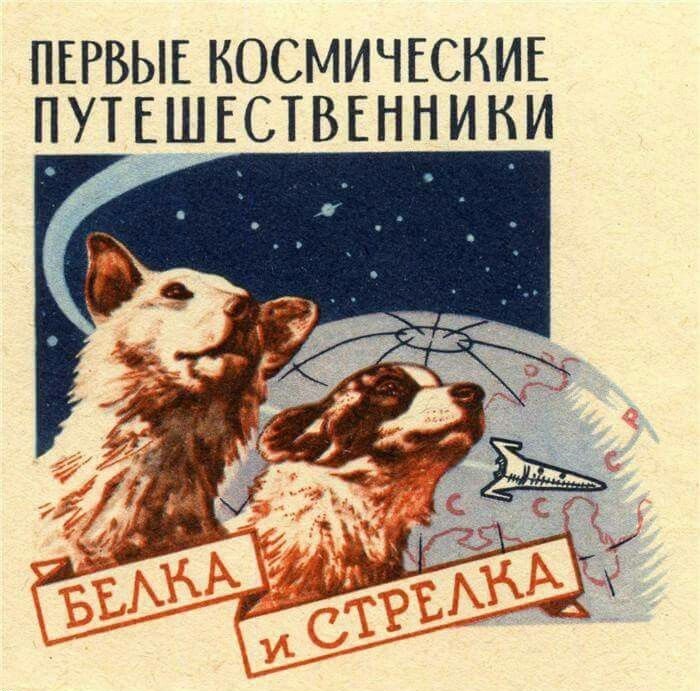
The next time dogs went to orbit, the Soviets put more care into their survival. On August 19, 1960, Korabl-Sputnik 25 took off from Baikonur Cosmodrome, carrying Belka (“Squirrel”) and Strelka (“Little Arrow”) aboard an early version of the Vostok capsule. A previous attempt in July had ended in disaster; the rocket had exploded less than thirty seconds into the flight, killing dogs Bars and Lisichka. This time, though, the launch went almost without a hitch, and the carrier rocket placed Korabl-Sputnik 2 safely into an orbit 300 kilometers high.


Hitching a ride with Belka and Strelka was a whole menagerie of creatures: 42 mice, two rats, a rabbit, insects, and plants. By observing their reactions to conditions in space, such as microgravity and cosmic radiation, Soviet scientists hoped to gain a broad-based understanding of the effects of space travel on living things. Belka did not adapt too well to weightlessness; she threw up her meal during the fourth orbit, which caused some concern on the ground.
On the seventeenth orbit, after twenty-five hours in space, Korabl-Sputnik 2’s retrorocket slowed their velocity and began their descent back to Earth. Belka and Strelka weathered re-entry behind the protection of a thick heat shield. Afterwards, once they were deep in the atmosphere, their escape pod ejected from the capsule and landed separately, much as future Vostok cosmonauts would use ejection seats instead of landing inside the spacecraft. V.S. Giorgiyevsky, a scientist on the rescue team, described how the dogs reacted when he let them out:
“As the apparatus was opened up, Belka and Strelka immediately recognized me and wanted cuddles. Their condition was good, even better than after some days in training. Their little noses were wet, the tongues – with which they were licking my hand – were pink. I calmed down and even let them go for a run around the steppe.”
Strelka would later have a litter of puppies. One of these, Pushinka (“Fluffy”), was presented to John F. Kennedy during Nikita Khrushchev’s 1961 visit to the United States, and she became a beloved part of the Kennedy household, bearing puppies of her own—Strelka’s grand-pups—whom JFK called “pupniks.” Strelka’s descendants are still alive today.


Korabl-Sputnik 2 represented a crucial step on the road to human spaceflight. The Soviet Union had not only sent animals into space, it had brought them back unharmed. Unlike the tragedy of Laika, abandoned to die on a one-way trip, this was an unmitigated success—but as the first manned mission approached, there would be more struggles ahead.
Paving the way for Yuri Gagarin
Several more dogs would fly on Vostok test missions. Next after Belka and Strelka came Pchyolka (“Little Bee”) and Mushka (“Little Fly”) aboard Korabl-Sputnik 3, which, like the previous mission, also carried a selection of small animals (mice, rabbits, and flies) alongside its canine passengers. The dogs took off on December 1, 1960, and spent about a day in space. All systems functioned normally during that time. Shortly before re-entry, though, the self-destruct system activated, blasting Pchyolka and Mushka to pieces a hundred kilometers or so above the Earth. Later investigation revealed that the deorbit rocket had fired improperly, putting the capsule on course to land outside the Soviet Union. The Soviets, ever conscious of state security, had installed an automated self-destruct for exactly that scenario. Better to blow up their own spacecraft than let it fall into the hands of the capitalists.

The backup capsule for Korabl-Sputnik 3 launched on December 22, without a formal name. Its passengers were Damka (“Queen of Checkers”) and Krasavka (“Little Beauty”). This flight, too, would suffer a serious malfunction, with the upper stage of the rocket cutting off midway through the burn that was supposed to put it into orbit. The capsule coasted to a height of 214 kilometers before landing 3,000 kilometers downrange—which is to say, central Siberia, in the middle of winter. Temperatures outside were a pleasant 40 degrees below.
Engineer Fedor Vostokov was dispatched to lead recovery efforts, joining a Soviet Army explosives expert and a search-and-rescue team from Krasnoyarsk. Simply finding the spacecraft was no easy task. Aerial reconnaissance failed to turn up anything during the first day. The following morning, December 24, the rescue team met with more success, spotting the intact capsule on a snowy plateau near Tura. For unknown reasons, the escape pod containing the dogs had failed to eject. Damka and Krasavka were still inside; whether they were alive remained to be seen.
Seeing as the self-destruct system had failed to trigger, again for unknown reasons, it was liable to go off at any moment. The rescue team had to tread carefully. But their explosives technician was a professional—he quickly found the self-destruct charges and cut their wires, allowing unimpeded access to the spacecraft. They first pried open the hatch to the capsule, then to the smaller escape pod nestled within it. The sound that greeted them was the barking of dogs.

Damka and Krasavka had survived, though they were very, very cold. They were wrapped in sheepskin coats and flown back to Moscow for medical treatment. Oleg Gazenko, in charge of the dogs’ training, adopted Krasavka as a family pet, and she lived another 14 years. The failure of this mission caused no small anxiety among the program higher-ups; on the one hand, the Vostok spacecraft had suffered two disasters in a row, but on the other, the Americans were fast progressing with their Mercury capsule, and could not be allowed to beat the Soviet Union to the prize of putting a man in orbit. Sergei Korolev decided to press ahead with more advanced test flights.

The next two missions took on a different format. Rather than pairs of dogs, Korabl-Sputnik 4 and Korabl-Sputnik 5 each sent up a dog and a life-sized mannequin of a cosmonaut. These were full dress rehearsals for Yuri Gagarin’s upcoming manned flight; the Vostok 3A capsules used were identical to the crewed Vostok craft, the only major difference being that they still had the self-destruct system, which would thankfully be omitted when humans traveled aboard. Based on the results of the Vostok 3A missions, Korolev hoped to give the go-ahead for Gagarin and Vostok 1.
Korabl-Sputnik 4 took off on March 9, 1961, carrying the dog Chernushka (“Blackie”) and the mannequin Ivan Ivanovich (the Russian equivalent of “John Doe”). Far from exploding like Korabl-Sputnik 3, or plunging into a Siberian winter like its follow-up, this mission escaped any such misfortunes. The spacecraft made a single orbit and then returned to Earth. Ivan Ivanovich took the ejection seat and parachuted the rest of the way, while Chernushka endured a somewhat rougher landing in the capsule. All told, Korabl-Sputnik 4 was a success. Things were starting to look up again for the Soviet space program.

Korabl-Sputnik 5 followed soon afterwards, on the 25th. With the dog Zvyozdochka (“Starlet,” named by none other than Yuri Gagarin), as well as another mannequin, it made a successful single circuit of the globe, proving that the technology for Vostok had matured at last. Zvyozdochka returned home unharmed, despite a snowstorm that delayed her rescue.
19 days later, on April 12, Yuri Gagarin thundered off the pad at Baikonur Cosmodrome, and the rest is history.
Kosmos 110, and the end of an era
Canine test flights dropped off sharply after Vostok 1. They were launching humans now, not dogs, and the effects of spaceflight became better understood, reducing the need for biological payloads. Korabl-Sputnik 5 turned out to be the penultimate adventure for the Soviets’ space dogs. The last was Kosmos 110, launched in 1966. This satellite was more or less a modified version of the crewed Voskhod capsule, itself derived from the Vostok design. Unlike the preparatory flights for Vostok, which spent at most a day in space, Kosmos 11o was up there for the long haul: three weeks. It was a record not to be exceeded until Soyuz 11 in 1971.
The dogs, Veterok (“Breeze”) and Ugolyok (“Little Piece of Coal”), passed several times through the Van Allen radiation belts, where Earth’s magnetic field concentrates charged particles in rings around the planet. Conditions there aren’t exactly good for you, but they aren’t an instant killer, either. For Ugolyok and Veterok, microgravity proved the more serious concern—both dogs returned to Earth dehydrated and weak from muscle loss, needing several weeks to recover their health.

Veterok and Ugolyok weren’t just the last Soviet dogs to travel into space. As far as I can tell, researching the long history of animal experiments in orbit, they were the last dogs to fly in space at all. Monkeys have gone up since then, and fish, and geckos, but no dogs. Part of the reason must be sentimental. Of all animals, dogs are the ones we’re fondest of, often treating them like our own family members. They’re adored and anthropomorphized far more than any other species we keep around us (except cats, maybe). That’s why stories like Laika’s are so hard to read. But perhaps, since we humans relate so much to our canine friends, that made them all the more suitable as our precursors in space. When the Soviets sent Laika and Belka and all the others into the great beyond, they were sending humanity, too.
A big thanks to everyone who gave this a read. Be sure to leave any thoughts in the comments below. If you enjoyed this, be sure to enter your email down below. Twice- or thrice-weekly, I post deep dives into space topics, reviews of sci-fi books and movies, and exclusive short stories, and you don’t want to miss them. Until next time!
- A sampling: The 1960 Nedelin catastrophe, which killed at least 54 technicians and military personnel on the launchpad; Soyuz 1, a craft that was rushed into orbit to meet a communist anniversary, and ended up killing its sole pilot, Vladimir Komarov, on landing; and Soyuz 11, which saw the rapid depressurization of the capsule and the deaths of all three cosmonauts aboard. But before you judge the Soviets too harshly, remember that they only ever lost four people during flight. NASA, between the two Space Shuttle disasters, lost 14. ↩︎
- According to one account, at least. It has also been claimed that she received her name because “Laika” is the Russian term for certain husky-like dog breeds, which she resembled. ↩︎
- Yes, the 1917 October Revolution really did happen in November. Tsarist Russia was backwards in many ways, and one of them was its calendar—Russia was among the last countries to phase out the Julian calendar in favor of the Gregorian one, which is now the global standard. Early November 1917 was late October in the old calendar. ↩︎
- Unless you count the microbes that hitched a ride aboard Sputnik 1—though they weren’t quite as photogenic. ↩︎
- “Ship-Satellite 2.” Also known in some accounts as Sputnik 5. ↩︎
Discover more from Let's Get Off This Rock Already!
Subscribe to get the latest posts sent to your email.