
Another personal essay for today—a kind of coming of age story, I suppose. For those of you not familiar with Portland, Oregon, which I assume is almost all of you, Tryon Creek is a large state park tucked away in the suburbs south of the city center, offering about twelve miles of trails and many hours of hiking. Highly recommended for anyone who happens to stop by!
With no further ado:
The summer of 2013 was a shadow. A shadow, because it occurred just after the momentous events of middle school; a shadow, because I accomplished very little and produced few records, and now wonder what I ever did with those long and unstructured days; a shadow, in very literal terms, because I would walk beneath the thick green treetops of Tryon Creek, down in the dark where the sun hardly reached.
***
Towards the beginning of July, I encountered a spider. A harvestman, if we’re going to be technical—about as close to true spiders as mites and scorpions. It was resting on a leaf by the trailside, an oval body supported by eight curved, springy, almost hair-thin legs, probably waiting for something edible to wander along.
I’ve hated those things ever since I was a kid. Their long legs are grotesquely out of proportion; they walk with an uncanny shambling gait, as if raised from the grave; their tiny faces and fangs reek of menace. So when I saw this creature—it came as a shock, appearing just a couple feet away as I marched down the trail—I did the only sensible thing, which was to whack it with a stick and send it flying.
There was some concern, afterwards, that it had landed on me. I half-expected to find it ascending my pant leg, or crawling in my hair. For the rest of that walk, I imagined its spindly legs on the back of my neck, and I eyed the undergrowth cautiously.

***
I always traveled light. I’d go out the door in jeans, a polo shirt, and worn-out loafers, with my archaic flip phone in one pocket and my house keys in the other. That was about it. No backpack or water bottle; at that age, I’m not sure I even carried a wallet with me. Thus unencumbered, I would wander the trails for hours and miles, deftly navigating dusty slopes, knotted roots, puddles of mud—any obstacle.
***
What’s the old adage? Wherever you go, there you are. It didn’t matter that I was deep in the woods, or that I hadn’t set foot on school property in more than a month, because the dreams and terrors of eighth grade were not so easily forgotten. They followed me everywhere.
Before middle school started, I had been very much a kid: fresh out of elementary, chubby, and utterly oblivious to social norms. But by July 2013, I was a teenager slowly pushing towards independence. I’d lost fifty pounds; I had amassed my own close circle of friends; I had started work on a novel, an epic of military science fiction which I was sure would top the bestseller lists. I had also, I believed at the time, fallen in love.
My more normal peers were certainly starting to date, getting into and out of volatile flings that provided limitless fuel for gossip. But for a young man with Asperger’s syndrome, the terrain was more difficult. The love lives of other students might as well have occurred on another planet, circling a foreign star thousands of light-years away, and I was an astronomer on some lonely, windswept mountaintop, picking up a faint and garbled transmission from which I tried to deduce the workings of alien minds.
Along came a classmate of mine. Let’s call her Minerva. She was quite popular, widely admired, known for her good looks and irresistible charm. Someone once described her as “otherworldly beautiful”; with her bright eyes, striking jawline, and short, dyed-blonde hair, she certainly stood out. Before the fateful encounter our orbits had crossed only once, in the cafeteria, when she remarked on my ridiculous stunt of drinking from four paper cups simultaneously, and it took until the end of April for me to even learn her name.
She was my gym partner, for a brief time. Everyone had already linked up, including my only friend in that class, and the teacher matched the leftovers, putting me and Minerva together for a series of fitness tests. Hoping to impress her, I blew away my personal record on the jump-rope. When I was doing sit-ups, she held my feet down, but I never returned the favor—I feared she would break if I touched her, as if she were made of glass. She tried chatting with me; I fumbled the conversation. She tried again, and I opened up a little, even getting a laugh out of her with a mediocre joke. So it continued for a couple weeks, until she gave up trying to crack my shell.
Afterwards I gave Minerva relatively little thought. Then, a week after graduation, I showed up to a friend’s birthday party—and she was there. It caught me completely off-guard, but I resolved to seize the opportunity. I thought I could make up for my previous failures; win her affections, perhaps. Over the course of the evening, I got a few interesting and friendly conversations, but nothing I could conclusively interpret. I did learn that she had at least a passing familiarity with Star Trek, and she showed at least some interest when my friend suggested a one-shot D&D game, so I dared entertain the notion that she would appreciate my own incredible geekiness. Things were looking up. By the time I left, I was dizzy with infatuation. Unfortunately I never did get her phone number.
Months later, on the dark trails of Tryon Creek, I spent a lot of time thinking about her.
***
I discovered much on those walks. I’d grown up in a different part of town, and had just moved into the neighborhood around the start of July, so I had no real knowledge of the place. To view the lay of the land on Google Maps seemed to me like a form of cheating. Every time I went in I found something new: a path, a knotted tree stump, a type of insect I hadn’t seen before. Since I only ever saw things from the ground, I got the sense that the trails just went on forever, that the finite geographical boundaries of the park enclosed an infinite space, whole troves of possibilities which I would never exhaust.
I only had to walk down the street and take a right. All told, it was eight hundred forty-three feet from the end of my driveway to the trailhead at the orchard.
***
When I remember a certain crossroads deep in the woods, I also remember a scene from my novel. They are linked together. Inseparable, really. This is common in my life, a natural consequence of brainstorming when I’m out on walks. To this day, scenes and characters from bygone stories hang like ghosts over the places of my youth.
The crossroads: Where the Cedar Trail intersected with the West Horse Loop. One or two unofficial trails also ended there, I think. The array of paths was disorienting and I didn’t know which one would take me home. It didn’t help at all that the trees were thicker than usual, blocking the bulk of the sunlight. Later I would think of this place as some kind of heart of darkness, far removed from civilization or sanity, but any satellite view will show that it’s seven minutes from the nearest park entrance.

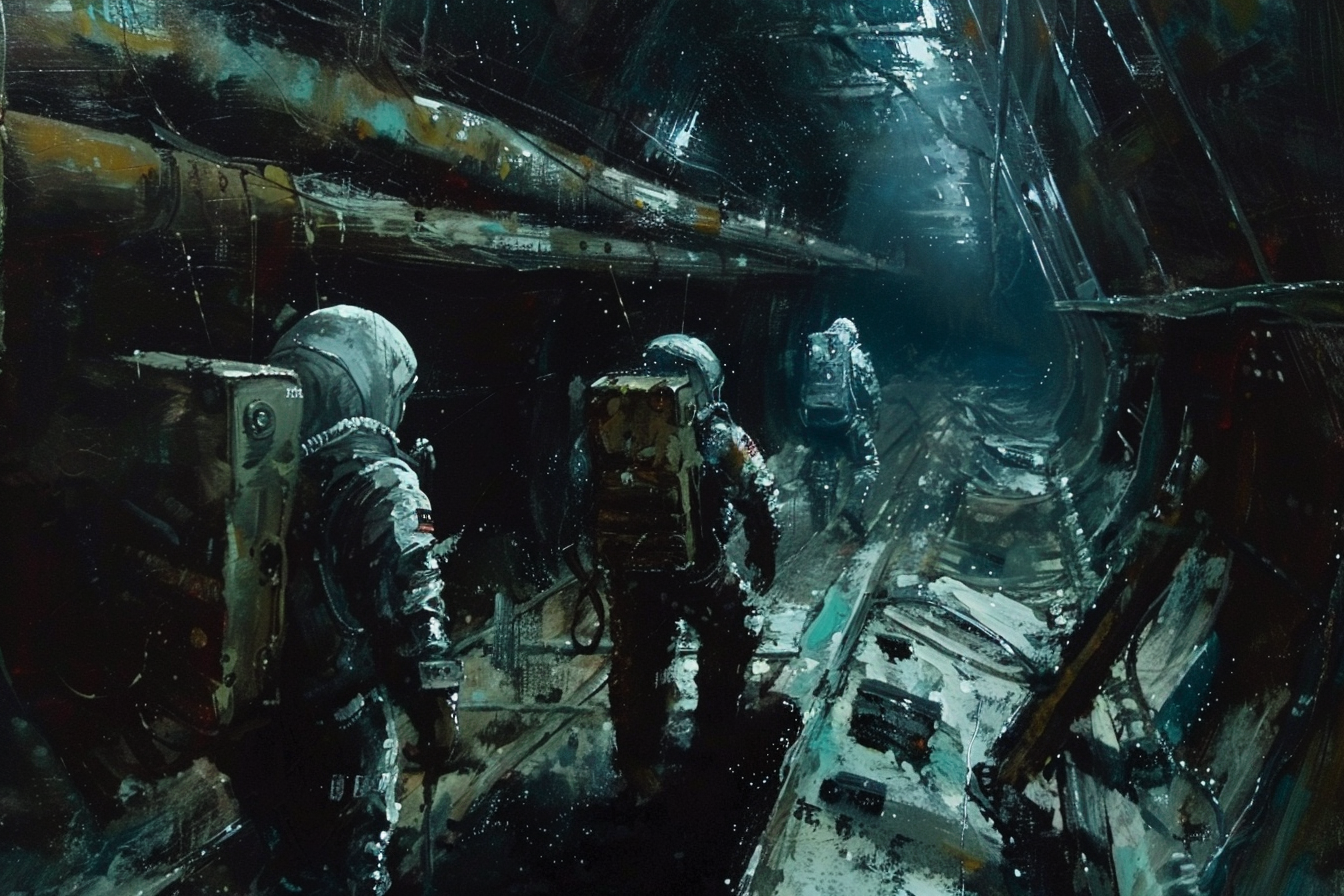
The scene: Space. Dark and cold. Following a cryptic message smuggled through back channels, an Imperial fleet has traveled by wormhole to a system light-years beyond the front lines, in the very heart of alien territory. Now our protagonist stands valiantly on the bridge of his flagship, facing the unknown. His name is Commodore Arthur Kenway. He is a man of about thirty, wearing a black uniform trimmed in red, a peaked cap over dark brown eyes. His gaze is fixed on the screen in front of him, where a derelict vessel drifts through deep space. Sensors show it is old; perhaps hundreds of years or more. If the rumors are true, it may predate the entire war—and harbor a deadly technological secret that could change everything.
In the years since, I forgot exactly what the deadly technological secret was. That’s what I get, I suppose, for never writing anything down that summer. But I remember the feel of that scene as clearly as ever. Cold, lonely, remote. Metal warships and distant stars. Not at all like the muggy, verdant forest, filled with unclean life. And Kenway was a strong, stoic figure—he didn’t pine for girls he hardly knew.
***
I always kept an eye out while walking. It wasn’t just to appreciate the scenery, or to watch my step on uneven ground, or even to avoid another close call with a harvestman. No, I was hoping to spot that most elusive of beings: my crush.
A mutual friend had told me Minerva lived in the neighborhood, presumably close to Tryon Creek, so it was not the most outrageous stretch to imagine that she also took walks there. What if we ran into each other? What would I say to her, if we crossed paths on the trails? Would we then explore together, conversing, sharing in the forest’s beautiful mysteries? I had a dim view of my social graces, but I desperately hoped I could manage a conversation, charm her somehow, inaugurate the grand summer romance that seemed to be a teenage rite of passage. I’d imagine whole stories where we talked for hours and fell dramatically into each other’s arms. But the person who inhabited my head was an almost total fabrication; I knew a few things about her, and extrapolated the rest.
The ghostly vision of Minerva accompanied me all throughout the woods. In reality, I remained alone, wandering a mental labyrinth of my own creation. I never spoke a word, and the trees never talked.
***
Why did I walk? I walked because I was bored. The summer dragged on forever, from mid-June to the end of August, and it provided no structure for my life. I couldn’t count on school five days a week; I woke up every morning without a plan, without any deadlines to put pressure on me, without any real obligations beyond a handful of chores, and while I had looked forward to such freedom during the school year, in practice it was miserable—computer games and television are only interesting for so long. Even my novel, which I’d planned to finish by the next school year, fell completely by the wayside. By summer’s end I estimate I’d only written about six hundred words. Miasma descended over me, and the idle and restless days passed by.
So, I walked. It was an excuse to get out of the house. I would walk for an hour, two hours, even three or more, navigating the trails that snaked and zig-zagged through the forest. What’s strange in retrospect is that I only ever went to Tryon Creek. While in later summers I would explore every street within walking distance, in 2013 I paid virtually no attention to the wider neighborhood—whenever I left for a journey, I was bound for the orchard, where the road ended, the sparse trees drew together, and the golden grass gave way to tangled green undergrowth. It was a magnetic pull.
I love forests and nature as much as anyone else, but that wasn’t what called me. No, I think it was the mystery of the place, the murk beneath the forest canopy, a dark and fevered abode for my dark and fevered imagination.

***
I think I actually did see Minerva once, somewhere in the forest. At the very least I encountered someone who looked like her. This woman had the same build—thin, about my height—and the same hairstyle, though it was auburn rather than the dark blonde she’d had at the party. She could easily have dyed it again. Somehow she seemed a little older, but that may have been a trick of the light.
The problem was that I wasn’t positive it was her. Growing up I had trouble recognizing people, a mild case of face blindness. To greet a stranger would have been unthinkably embarrassing. So when she smiled, I smiled feebly back, and we walked past each other.
***
September. The school year was in and the days of idleness were over. After three months, I had no achievements to speak of. No novel, no ideas, no schoolwork. And my long-hoped-for reunion with Minerva faded to impossibility when I learned she’d transferred to another district; I never saw her again.
I did still go to Tryon Creek. Two years later, it was the site of some brainstorming for my first complete novel, though I moved away shortly afterwards. In 2019 I traveled there by bus, and got bitten by an unreasonable number of mosquitoes. As recently as February 2020, I planned to visit the place with a woman I was then dating, though she didn’t like hiking very much and quickly bailed. Tryon Creek remains on the very periphery of my life, if not the center.
But it never was the same. After the end of that summer, those delirious few months in 2013, the wilderness transformed into nothing more than a large park. The fever had broken; the forest was just a forest.
Thanks for giving this one a read! Drop any feedback in the comments below, or shoot me an email at nicq98@gmail.com. I’ll see you all next week with a piece about some four-legged pioneers of the Space Race…
Discover more from Let's Get Off This Rock Already!
Subscribe to get the latest posts sent to your email.




















Leave a Reply