
This piece is going to be about something very local. While I know I have a far-flung readership—just last week, I had visitors from Germany, South Korea, Thailand, and Poland, among others—it may still be of use for those of you who will one day visit the great state of Oregon. And for those who won’t, you’ll at least get to see some pictures of planes and rockets. Our subject today is the Evergreen Aviation and Space Museum, an overlooked gem boasting a collection that punches far above its weight—and with the benefit of some pictures from my last visit, I’ll be taking you on a little tour.
You can find the museum in McMinnville, a rural-ish town that is otherwise home to wineries and a liberal arts college. The location is about fifty minutes southwest of Portland. Ever since I was a small child, it’s been a frequent target of day trips, usually with my dad or my friends, and it is wrapped up in more than a few fond memories. I sometimes joke that I consider it a site of pilgrimage, like a cathedral hosting the bones of some medieval saint. There is, indeed, a whiff of the transcendent about that place—in its vast windows, admitting shafts of sunlight on lazy summer days; in the sight of fighter planes and spacecraft hanging weightlessly overhead, populating the gap between the museum floor and the remote ceiling; in its earnest, patriotic display of achievements long past, reminding younger generations of what came before them.


There are four major buildings on campus. All the exhibits are in or around two gigantic, sloped-roof, hangar-like halls, easily spotted from the nearby highway. The aviation hall houses the centerpiece attraction, the mammoth Spruce Goose, which towers over an assortment of civilian planes and military aircraft from the Wright Brothers to the Vietnam War; the space hall focuses, naturally, on the history of spaceflight, while also hosting some modern jet fighters and drones. Between them is a smaller building containing a movie theater. There’s also a themed water park, Wings and Waves, but I, being firmly a creature of dry land, have yet to explore that one.

The museum was founded in 1991 by Delford M. Smith, owner of Evergreen International Aviation. Initially, it was a small operation at the company headquarters, but in the mid-1990s Smith acquired the Spruce Goose from a failed Disney theme park in California, and he set about erecting a brand-new exhibit hall around it, which opened to the public in 2001. The space wing opened seven years later, recently enough for me to remember the change. Some serious budgetary problems hit in the mid-2010s—Smith’s passing left behind a dodgy financial situation, in which the museum was entangled—but they are now largely past, and these days the Evergreen Aviation and Space Museum continues its work of educating Oregonians about aviation and space history.

The first thing you’ll notice, upon entering the aviation hall, is the sheer size of the Spruce Goose. Its 320-foot wingspan stretches most of the way across the building. Its fuselage is as tall as a multi-story home. Everywhere you look, there is no escaping that tremendous grey bulk, crafted almost entirely out of wood. This vehicle is truly one of a kind; it was the brainchild of eccentric tycoon Howard Hughes, sort of a 20th-century Elon Musk, who built it to fly transport missions across the Atlantic during World War II. Unfortunately it missed the war, and took only one short flight in 1947 before being mothballed. Visitors can take a gander at the the cargo bay—truly an impressive volume, intended to carry tanks—and even go on a guided tour up to the cockpit.
You will also spot plenty of docents wearing green vests, sitting by the front or walking around the floor. A lot of them are veterans, and in many cases, they actually flew some of the aircraft on display. I would recommend taking every opportunity to chat with them. They’re really great guys, passionate about history and eager to share knowledge with anyone who asks.

The aviation hall is loosely organized by chronology and context. First after the entrance is a small collection of biplanes, including an exact replica of a World War I Sopwith Camel built by a man and his son in Eugene. Once you’re through that section, you’ll find yourself up against the hull of the Spruce Goose, where you’ll start encountering military aircraft from Vietnam and World War II. The A-4 Skyhawk, F-4 Phantom, and PBY Catalina are particular highlights; around the Spruce Goose‘s tail you’ll also spot an F-105 Thunderchief and an F-100 Super Sabre, rounding out the Vietnam collection. These are all impressive, mean-looking machines, the kind I used to play with as toys in my childhood therapist’s office, making “Woosh!” and “Kaboom!” noises as I gleefully enacted mock air battles1.


Over in the far corner from the entrance they used to have a flight-condition B-17 Flying Fortress, in which I celebrated my twelfth birthday with a guided tour. Sadly, the museum sold that one off during the recent period of financial woes, and it has been replaced with a 1940s passenger aircraft, gleaming silver and painted with the livery of a long-vanished airline. It’s cool, but not the same. I like my bombers.
Other notable planes in this section include an A-26 Invader, a light attack plane used during World War II for interdiction and tactical strikes; a Messerschmitt Me-262, the world’s first operational jet fighter, which caused some shock when the Germans used it against Allied bomber formations; and a MiG-17 Fresco, a swept-winged barrel of a jet originating in the Soviet Union. An exhaustive list would probably put you all to sleep, but let that be a testament to the sheer breadth of history on display here.

Now, let’s take a step outside. The museum has a number of aircraft sitting around the grounds, generally in good condition—though some of the informational plaques are sun-bleached beyond legibility, and there seems to be a family of sparrows nesting in a wheel well of the F-14 Tomcat. Most of these are jets of recent vintage. In addition to the aforementioned F-14 there’s a MiG-29, probably the most advanced fighter the USSR ever made before its dissolution, and an F-102 Delta Dagger, a pointed brick of a plane meant to intercept Soviet bombers flying over the North Pole.

Moving across the parking lot you’ll pass by the theater, which is built like a smaller version of either of the two exhibition halls. Tickets are reasonably priced, at $7 on top of the $22 base admission fee2, and I’ve seen a handful of movies there over the years. The auditorium is of cinema quality, with good sound and a gigantic screen. They have a standard lineup of middling-quality educational films; occasionally, they’ll also take advantage of their 3D capabilities to screen a Hollywood blockbuster, such as Top Gun: Maverick or Avatar: The Way of Water.
At the far end of the parking lot, then, you’ll find my personal favorite: the space hall. It is an enchanted place. The collection is smaller than in the aviation wing—spacecraft are, unfortunately, much harder to come by than retired planes—but Evergreen more than makes up for it with richly immersive exhibits, a series of curved informational panels guiding the viewer from the dawn of rocketry to the present day. It’s a wonderland of history and artifacts and echoing speeches, in which you could lose yourself for hours.


Rockets on display include a replica V-2, as well as a Redstone missile and Titan II which are decidedly the real deal. The Titan II, being much taller than the height of the building, has been placed in a kind of sunken launch silo, complete with a control room you can visit. There are also plenty of engines, spacesuits, Russian newspapers, and other artifacts from the heroic early days of spaceflight. A small room contains an unflown Mercury capsule, America’s first manned spacecraft, encased in glass under reverent lighting. Looking into its cramped, instrument-cluttered interior, you get a sense of how rough-and-tumble NASA could be back then; small wonder the Mercury-7 astronauts used to joke, “You don’t get in, you put it on.”


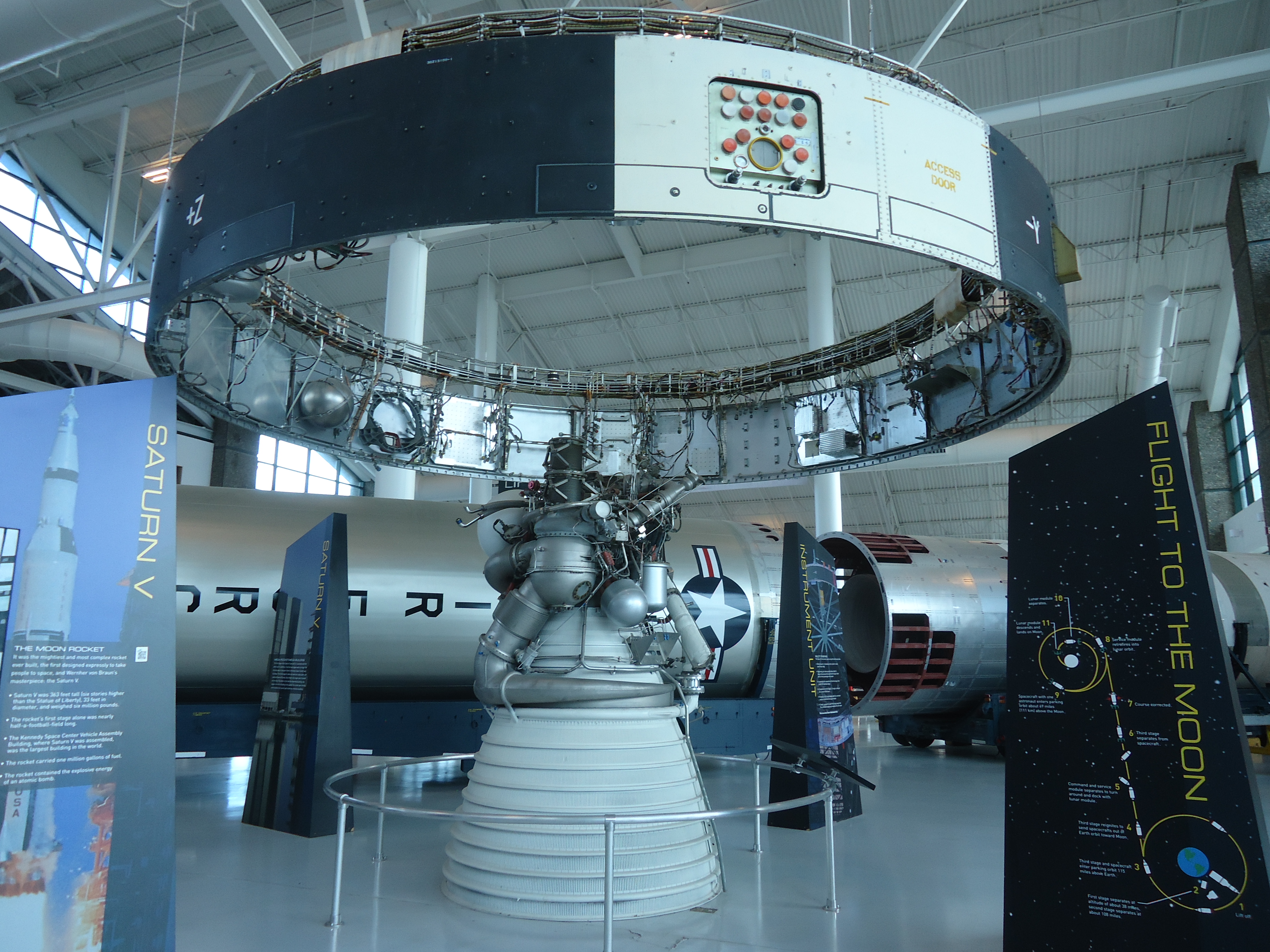
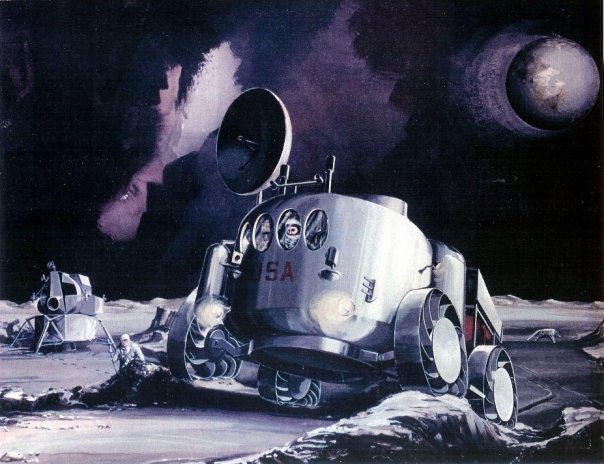
Mercury has its moment, as do Gemini, Vostok, Voskhod, Skylab, Salyut, the Space Shuttle—the exhibits stretch on program by program, impressively comprehensive as far as human spaceflight goes. Unmanned exploration gets comparatively short shrift, though there are replicas of a Soviet Venus probe and the American Opportunity Mars rover. The pièce de résistance, of course, is the Apollo program, the triumphant culmination of the Space Race, the only time (so far) that human boots have trod the soil of another world. A diorama of a lunar lander and rover dominates its corner of the space hall. Nearby are various examples of genuine Apollo equipment, from hammocks and food pouches to an enormous avionics ring from the Saturn V’s third stage.


Even all those exhibits are not enough to fill up the space hall’s truly considerable floor area. As such, it’s also home to some of the museum’s odds and ends, including a selection of helicopters and several modern-day military aircraft. Most notable among the latter is the Lockheed SR-71 Blackbird, a high-speed, high-altitude reconnaissance jet of which only 32 were ever built. It is a frighteningly fast plane, and looks the part. I’m kicking myself for not snapping a picture last time I was there, but here’s what it looks like in flight:


That more or less rounds out our virtual tour. I’ll finish up with an anecdote: once, when I was in tenth grade, the space hall at Evergreen was the venue for my robotics team’s qualifying tournament, an event which would normally have happened in some grungy high school gym. You can imagine I was pretty thrilled. They set up the playing field by the SR-71, and projected game results onto the fuselage of a Titan missile. This being robotics, we were all huge nerds and had a terrific time there, though I doubt our coaches appreciated us constantly wandering off to look at the exhibits—every so often they’d have to go out among the rockets and corral us back in.

I do love my local air museum, and I am tremendously fortunate to live near it. It’s really something special to come so close to history, to see with your very own eyes a plane that flew combat missions over Germany, or a rocket engine built when the Space Race was still an open question. There’s abundant heroism on display, and societies need heroes. They need grand narratives, something from the past to collectively uphold and celebrate. While the job of historians is to argue endlessly about this or that interpretation of events—and I should know, I almost became one—there is a place, too, for mythmaking, by which identities are formed and nations are made. Evergreen Aviation and Space Museum performs that role splendidly; I wouldn’t have it any other way. Should any of you ever swing by the Portland area, I can’t recommend too highly that you give this place a look.
Thank you all for reading—I will see you next time! My posting schedule should be every Monday morning from here on out.
- Truth be told, I’m sometimes tempted to do the same in my current therapist’s office, which boasts a bin full of extremely wooshable toy planes. ↩︎
- Note that active-duty military gets in free, and veterans receive a steep discount. ↩︎
Discover more from Let's Get Off This Rock Already!
Subscribe to get the latest posts sent to your email.























Thank you Nic – well done
Another gem is the Kansas Cosmosphere
Yes! I recently put that one on my bucket list. Have you been there?