
Below is a list of the known stars1 and stellar systems within a ten-light-year radius of the Sun. See if you can notice anything strange about them:
- Alpha Centauri (A and B, plus Proxima Centauri).
- Barnard’s Star.
- Wolf 359.
- Lalande 21185.
- Sirius (A and B).
- Luyten 726-8 (A and B).
- Ross 154.
There are familiar, straightforward names like Sirius and Alpha Centauri, and then there’s Luyten 726-8, and Ross 154, and Lalande 21185. Some of these things are not like the others. What’s going on here? Well, while Sirius and Alpha Centauri (A and B) have been known to humans since ancient times, all the others were discovered recently, using high-power telescopes, by astronomers who put them in star registries under thoroughly unromantic names. Of the eleven stars nearest to us, fully eight of them are so faint as to be invisible to the naked eye. Of those eight, seven2 are members of a quiet, humble, but utterly ubiquitous species: red dwarfs. They are small; they are temperamental; they are extraordinarily long-lived. Today we will explore the wide world of these miniature suns, which, as dim as they are, comprise an estimated seventy-five percent of all stars in the universe.
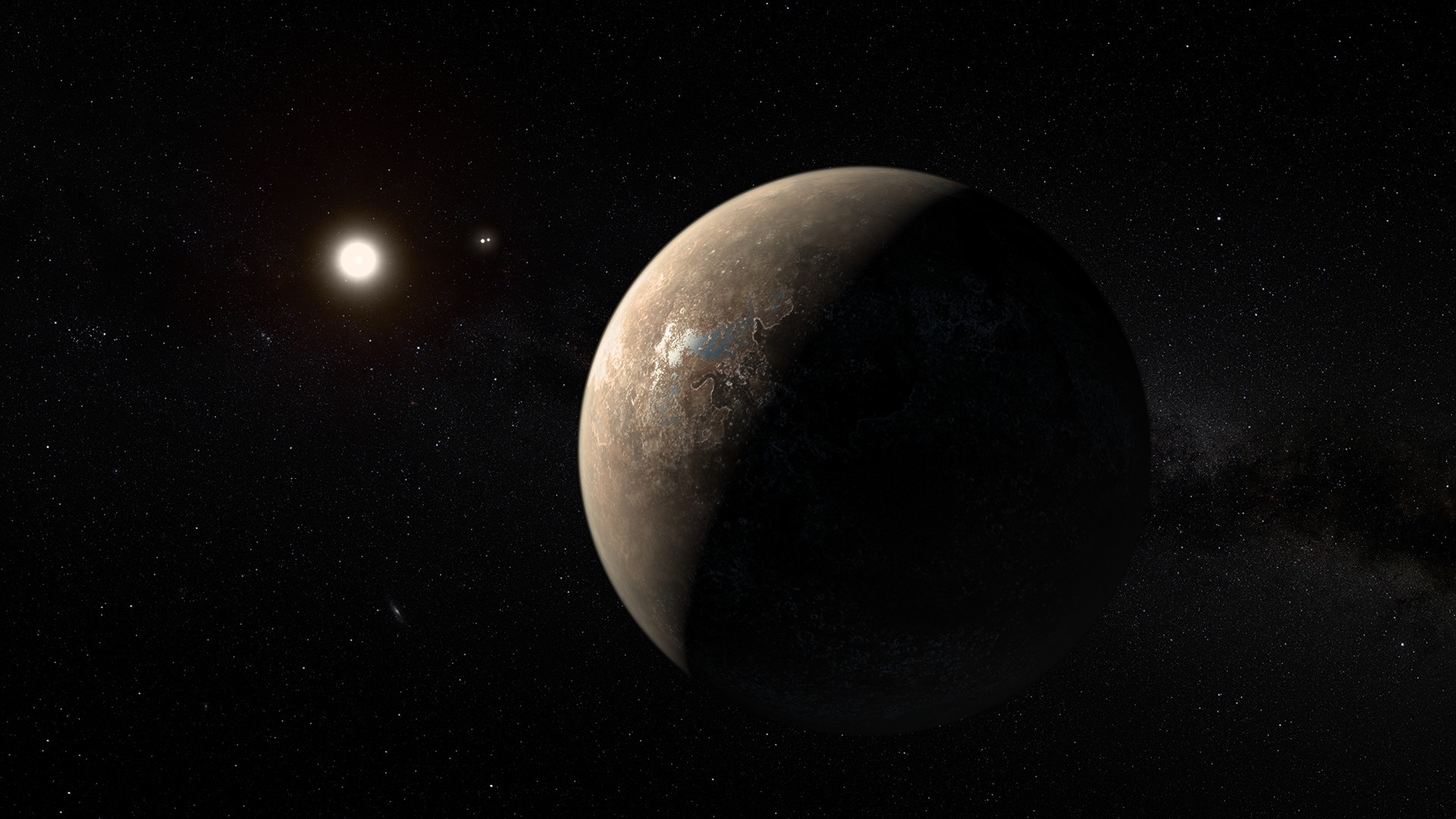
I’ve touched on the subject of red dwarfs a few times before. My story last week featured an unmanned voyage to Proxima Centauri; I’ve also discussed tidally locked “eyeball worlds“—common around red dwarfs—and TRAPPIST-1, a specific red dwarf system host to numerous Earth-sized worlds. Now, however, what I would like to do is delve into the stars themselves, and learn what makes them tick.

Let’s start with definitions. We’ll need to consult what astronomers call a Hertzsprung-Russell diagram (pictured above). This is essentially a scatter plot of stars, sorted according to their luminosity and temperature. Brighter stars are at the top and cooler ones towards the bottom, while for the x-axis, hotter stars are on the left and cooler stars are on the right. The x-axis is subdivided into the spectral types O, B, A, F, G, K, and M. Aside from white dwarfs, which form an outlying cluster of hot but dim stars on the bottom left, and the red giants and supergiants, which are cool but bright, the majority of stars occupy a diagonal curve down the center, known as the main sequence. The Sun is a G-class star about halfway down this curve. K-class stars are the next step down, ranging from about 0.5 to 0.8 solar masses; they are commonly known as orange dwarfs. Finally, M-class3 stars lie at the far end of the main sequence—the smallest of them are only seven percent as massive as the Sun, and ten thousand times less luminous. These are our red dwarfs.

Being small main-sequence stars, red dwarfs share many processes in common with the Sun. Just like our own star, they are gigantic balls of incandescent plasma, hurtling through the cosmos, powered by the fusion of hydrogen into helium within their cores. It is the same principle as a thermonuclear bomb; intense heat and pressure combine atoms into heavier elements, releasing energy in the process. This energy travels to the surface via convection currents—looping cycles of plasma that rise towards the surface, cool off, and sink back towards the core—and then it hurtles out into the cosmos as electromagnetic radiation: visible light, infrared, ultraviolet rays, and so on.

This process continues until there is no more hydrogen left in the core, at which point the star will enter the last phase of its life. Large stars burn through their hydrogen very quickly. Supergiants last for only a few million years, the blink of an eye on a cosmic scale, and then meet violent ends as supernovae. The Sun, meanwhile, is 4.6 billion years old, with about five billion remaining before it sheds its outer layers and becomes a white dwarf. Red dwarfs are the longest-lived; they are so long lived, in fact, that none of them have died yet, because the universe just isn’t old enough. Some will continue to fuse hydrogen for tens of trillions of years.
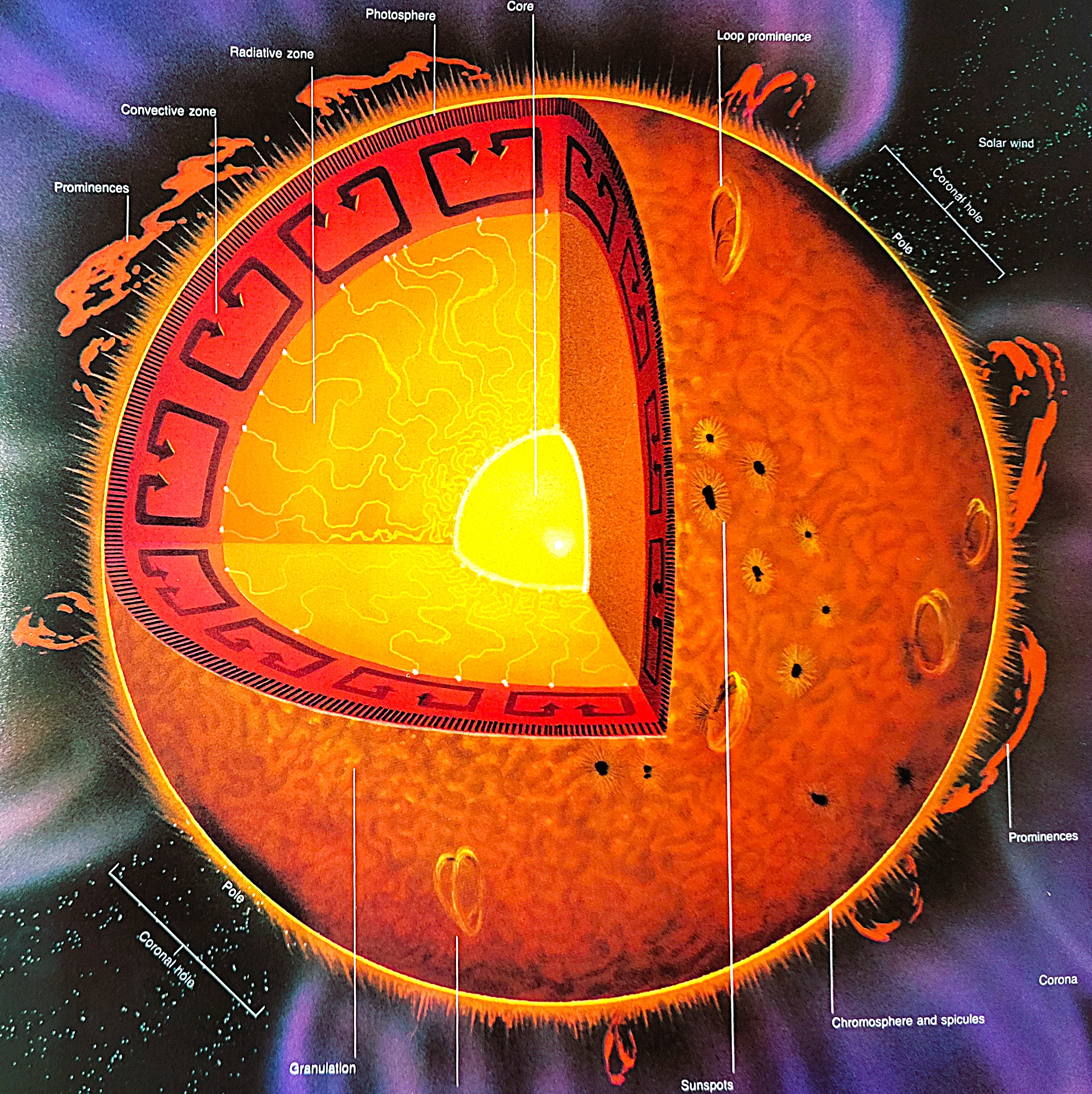
What gives them this longevity? Part of it is simply that they consume less fuel, as red dwarfs are small and cool, and they don’t sustain very many fusion reactions at one time. But there is also a key structural difference between these stars and their larger brethren. The answer lies in the convection currents we discussed earlier.

Take a look at the image above. Inside medium-sized stars like the Sun, the convection currents don’t go all the way to the center, because inner regions are so hot and dense that energy is transferred by radiation instead. Without convection, the core has less physical interaction with the rest of the star. Fresh hydrogen comes in at a slower rate, with much of it never getting used at all, while the end products of fusion tend to build up in one place, forming an inert core of non-fusing helium. You can think of it as an inefficient car engine that doesn’t burn all its fuel, and is steadily getting clogged up with carbon and other detritus. An engine like that isn’t going to run for very long; the same is true of stars.
For red dwarfs, on the other hand, internal temperatures are low enough to allow convection all the way from the core to the surface—making a vastly more efficient engine. Convection cycles prevent helium from accumulating, while also bringing in hydrogen that would otherwise go to waste. Thus, there is a constant process of circulation at work, sustaining and renewing red dwarfs until the natural depletion of their hydrogen in the distant future.

The longevity and stability of red dwarfs does not, however, mean they are peaceful. Here we arrive at another quirk of these stars: their tendency towards solar eruptions, of such violence as to throw the habitability of any nearby planets into serious doubt. About two-thirds of red dwarfs are classified as “flare stars”; these are stars that undergo sudden increases to several times their normal brightness. Proxima Centauri, for example, became sixty-eight times brighter than usual for a few minutes in 2016, enough for it to be visible to the naked eye. These flares are estimated to occur about five times a year, though telescopes don’t usually catch them.
Once again, this has to do with convection cycles. Convection may replenish fuel at the core, but it also represents an enormous movement of charged particles. Magnetic fields, as you may remember from physics class, are generated by moving charges. This means that red dwarfs have enormously powerful magnetospheres, even stronger than our Sun’s. When you take into account the very fast rotation of such stars, the result is a roiling vortex of energy, prone to twisting and tangling as the magnetic field turns over itself—and then every so often, violent release.

Consequences for planets around red dwarfs are expected to be dire. Not only would periodic bursts of radiation make survival very difficult for life as we know it, but it’s possible that such worlds wouldn’t even have atmospheres in the first place, with hyperactive stellar wind pushing away all but trace gases within the first billion years or so after formation. Whether planets around M-dwarfs can retain their atmospheres is one of the most consequential open questions in astronomy. Since more than three-quarters of all stars are red dwarfs, the habitability of red dwarf systems could make the difference between a universe teeming with life and one where we’re all on our own. Preliminary observations of the Trappist-1 system, while not conclusive, haven’t exactly been promising.

What to make of all this? For one thing, red dwarfs and their planetary systems are an exciting frontier of astronomical research, particularly now that telescopes like James Webb are studying them in detail. They may or may not be potential abodes for life; the jury’s out on whether any planetary atmosphere can survive their constant barrages of solar flares. For another, I would argue that living around a star like our Sun has given us a skewed idea of what counts as normal—and we’re all due for a change of perspective. Even the stars you see when you look up at the night sky are the exception, not the rule. They are hot, and brilliant, and ultimately short-lived. The real bulk of the universe lurks around them, unseen: a legion of red dwarfs, a whole shadow galaxy of dim yet temperamental stars, biding their time until they are all that’s left. Trillions and trillions of years from now, they will still be chugging along as if nothing has changed.
Thanks for giving this one a read today. As always, be sure to drop your email in the sidebar if you’d like to catch my posts as soon as I write them. Until next week, everyone!
- Not including Luhman 16, a binary brown dwarf system 6.5 light-years away, or WISE 0855-0714, a rogue planet 7.4 light-years away, since they are not stars. ↩︎
- The eighth is Sirius B, a white dwarf—the burnt-out husk of a star, which has ceased fusion of any kind, and now only radiates residual heat. ↩︎
- Note that not all M-class stars are red dwarfs. For example, the red supergiant Betelgeuse, well off the main sequence, shares a spectral type with humble little Proxima Centauri, on account of its very cool surface temperature. ↩︎
Discover more from Let's Get Off This Rock Already!
Subscribe to get the latest posts sent to your email.





















Leave a Reply