
This movie is deranged. But that’s a good thing. Today’s subject: Mad God, crafted over 30 years by animator Phil Tippett, a work of staggering ambition that is not for the faint of heart (or queasy of stomach). Let us venture into the realms of madness, now, and take a look.

First off—who is Phil Tippett? A man with one hell of a resume is who he is. Tippett has had a long, long career in special effects and creature design, playing an instrumental role in Star Wars, RoboCop, Jurassic Park, and Starship Troopers. Around the time of Jurassic Park he pivoted from stop-motion to CGI; nevertheless, he has clearly retained a fondness (and genius) for practical effects, as evidenced by Mad God. He started the project in 1990, producing a few minutes of footage. It sat dormant until 2012, when close colleagues in his studio saw the old footage and persuaded him to go all the way—so Tippett gathered a crew of volunteers, launched a Kickstarter campaign, and made his dream happen.

Our film begins with what appears to be the destruction of the Tower of Babel. Stop-motion figures pull blocks of stone up the sides of a vast spiral monument, under the watchful gaze of their leader (god?) lurking at the top. Dark clouds close in; the figures scream, to no avail, and are crushed. We then see a passage from the Book of Leviticus: “IF YOU DISOBEY ME AND REMAIN HOSTILE TO ME I WILL ACT AGAINST YOU IN WRATHFUL HOSTILITY. I, FOR MY PART, WILL DISCIPLINE YOU SEVENFOLD FOR YOUR SINS. YOU SHALL EAT THE FLESH OF YOUR SONS AND THE FLESH OF YOUR DAUGHTERS. I WILL DESTROY YOUR CULT PLACES AND CUT DOWN YOUR INCENSE STANDS, AND I WILL HEAP YOUR CARCASSES UPON YOUR LIFELESS IDOLS.”
Really sets the mood, I think.

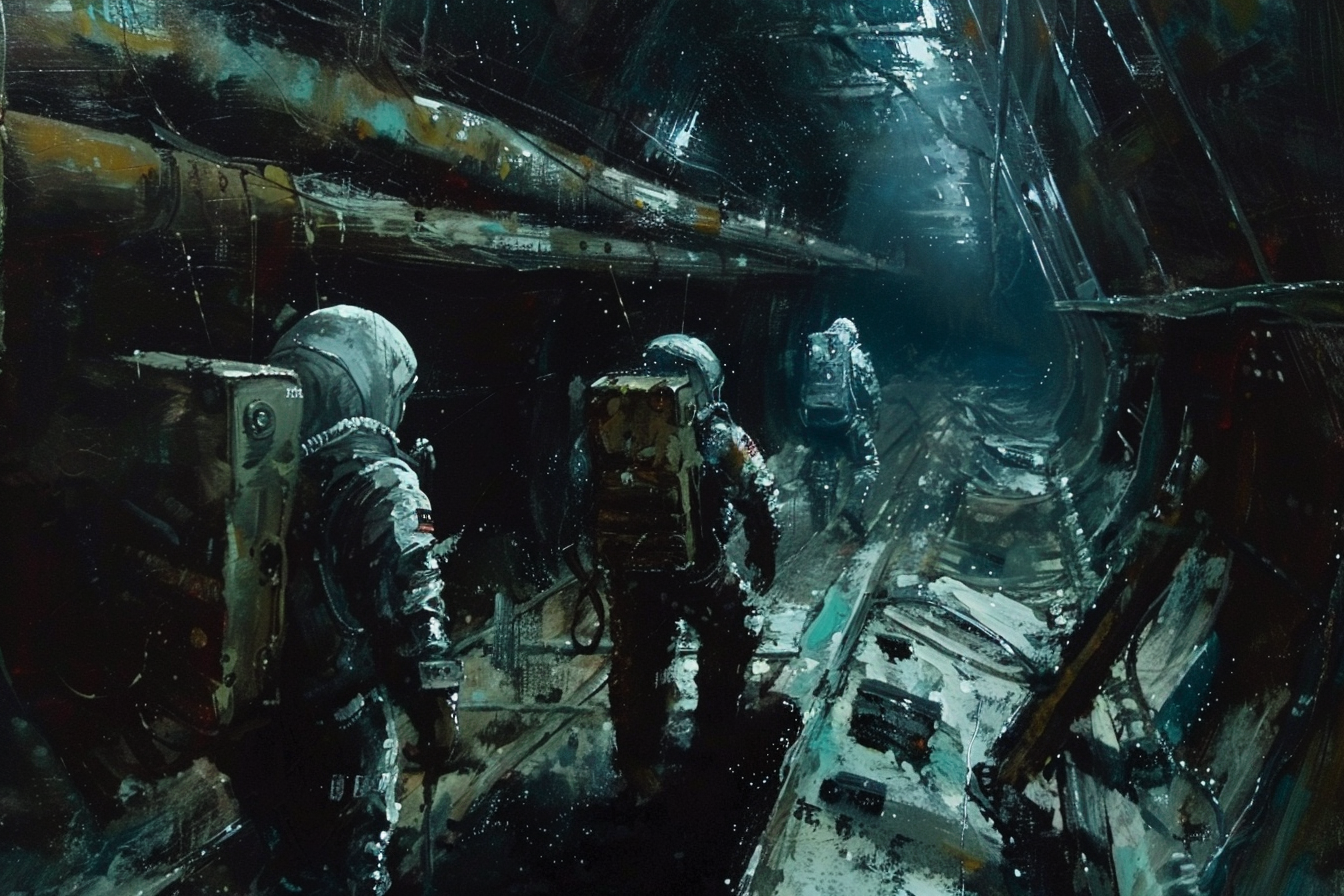
The protagonist of Mad God, such as it has one, resembles a World War I soldier, hidden beneath a helmet and gas mask. He has no name, though he’s listed in the credits as the Assassin. He appears to be on some kind of mission; with his cargo, a nondescript briefcase, he descends in a diving bell through the layers of a surreal nether world, following a map that crumbles a little more every time he tries to read it. When the diving bell finally comes to rest, he continues on foot. It is a long way down.

There isn’t much of a plot, nor is there any dialogue (at least, not anything intelligible). Mad God is more of an experience than a story. I will not belabor the exact sequence of events, but I will give you a preview of the bizarre scenes on display:
- The Assassin explores a vast subterranean city, rumbling with machinery, populated by countless thousands of thin, wiry figures that shuffle mindlessly through their duties. Life is cheap here. They are killed without thought, crushed and burned and eaten by monsters, then replaced just as easily. The god of this realm is a mouth on a screen, speaking only in meaningless childlike babble.
- Doctors in surgical masks cut open the chest of a patient strapped to an operating table. They reach deep within the bloody, slimy chest cavity of their victim, pulling out coins, sodden papers, and finally a screaming, writhing… thing.
- We visit the lab of a mad scientist, small and hunched-over, his face swollen grotesquely with tumors. Snarling beasts shovel excrement into piles, and he tortures them with electric shocks whenever they step out of line. He keeps a terrarium brimming with psychedelic plant life; on a whim, he unleashes monstrous spiders to kill and eat its small inhabitants.


The world of Mad God is dark, disgusting, and shockingly cruel. Yet, it pulls you in with irresistible force, like a dream you can’t wake up from. According to Tippett, in interviews, it is quite literally a nightmare put to film. The imagery draws from the subconscious and the spiritual in ways that can’t quite be related secondhand. Really, there is only so much I can do to describe this movie. It is a feast for the imagination, and there is absolutely nothing else like it.
The effects work is truly phenomenal. Stop-motion always has a kind of eerie, otherworldly feel to it, and Tippett exploits that to maximum effect here. There is not a frame of CGI to be found—it’s all practical! There are a few scenes with live-action actors, but of course, they don’t speak, and their appearances are as dreamlike as the rest of the film.

The soundtrack is quite good, too. So are the sound effects—so much squishing, squelching, and squirming, lending the creatures of Tippett’s fevered imagination a realness far beyond their origins as clay miniatures. Though it can be nausea-inducing. Many fluids flow here, in graphic detail. There’s stuff in this movie to make your skin crawl.

Frankly, I don’t have anything bad to say about Mad God. It is an exercise in pure creativity, a passion project of a kind very rarely seen. Every choice in this film was deliberate. Every idea came from a genuine human mind. Seeing how grim things are right now in the worlds of art, cinema, and literature—an ever-rising tide of AI slop floods the internet, while “marketability” pressures creators to fit within narrow boxes—it’s downright refreshing to see something like this, which spits in the face of convention and refuses to commit to a genre. Phil Tippett, I salute you!
I’d also like to thank my friend Holly for letting me borrow the copy she has on DVD. Otherwise, Mad God is available on a variety of streaming platforms, including Shudder and Amazon Prime. I highly encourage you to watch it—if you’re brave enough.
Rating: 10/10.
Discover more from Let's Get Off This Rock Already!
Subscribe to get the latest posts sent to your email.






















Leave a Reply